The Weekly: The Race to List Everything
JUN 29, 2026
STRC trades below par as Bitcoin's price swings expose its credit risk, while RWA perpetual futures volume surges to $30B weekly, led by commodities ahead of an expected equities boom. Plus: stablecoin lending yields on Aave, Pendle fixed-rate returns, and Lido staking rates for the week.
Re7 Capital wins Best Performing Fund in DeFi at The Hedge Fund Journal’s Digital Currency Awards 2026
Re7 Capital’s market-neutral fund has won an award in the DeFi category — Best Performing Fund in 2025 and over 2 and 3 Years — at The Hedge Fund Journal‘s Digital Currency Awards 2026.
Re7 Labs is hiring a Senior DeFi BD Lead
Re7 Labs, the strategy curation arm of Re7 Capital, is hiring a Senior DeFi BD Lead to own its pipeline across vault deployments, ecosystem partnerships, and tokenised fund distribution.
The role sits at the heart of Re7's growth, working closely with leadership to expand its footprint across DeFi.
Apply here → Link
Weekly Summary
We cover:
Why STRC is trading below par, and what the market is really saying about Bitcoin-backed credit risk.
The rise of RWA perpetuals, as volumes reach new highs and on-chain venues capture an increasing share of activity.
Why equities could be next, and how new listing frameworks are expanding crypto’s addressable market beyond digital assets.
Market Update
Crypto markets have continued to consolidate around the $2T mark with no rotation yet from previously leading sectors like semiconductors and hyperscalers.
Yet, downside momentum appears to be exhausted right around the 18 month support area.
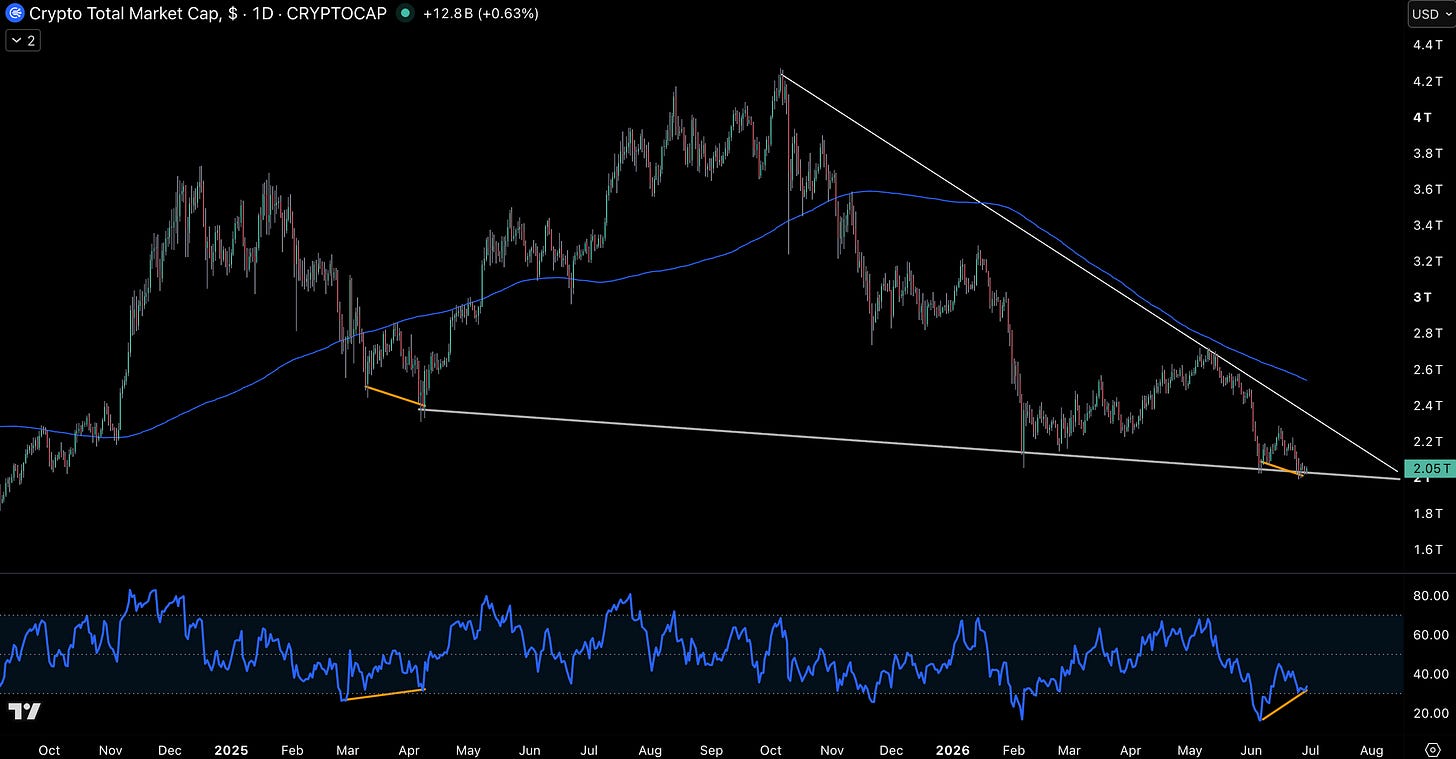
Global crypto market capitalisation ($; daily).
The AI trade has been cooling off just as forward looking global liquidity trends indicated that would be the case for the next month…right on cue.
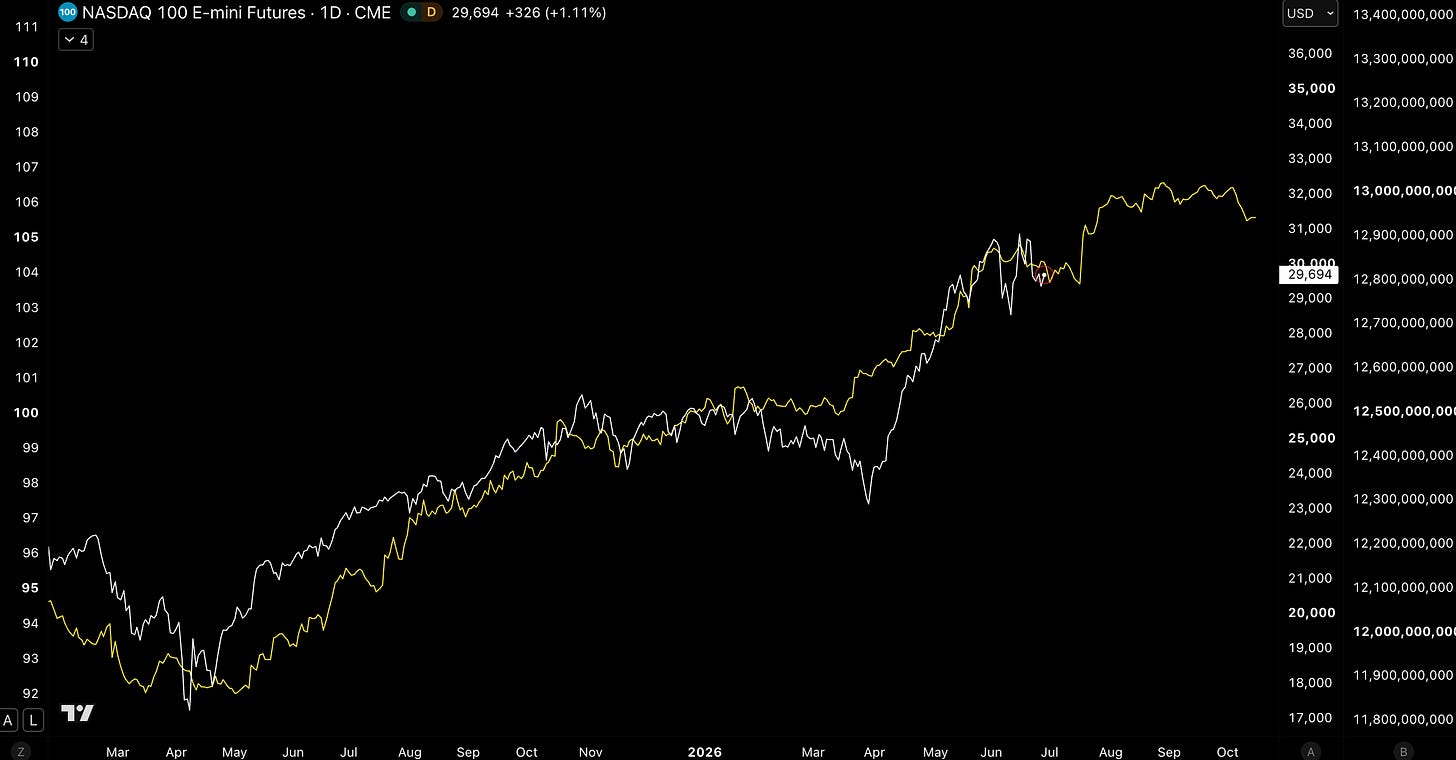
NDX futures vs. global liquidity (80 day lead).
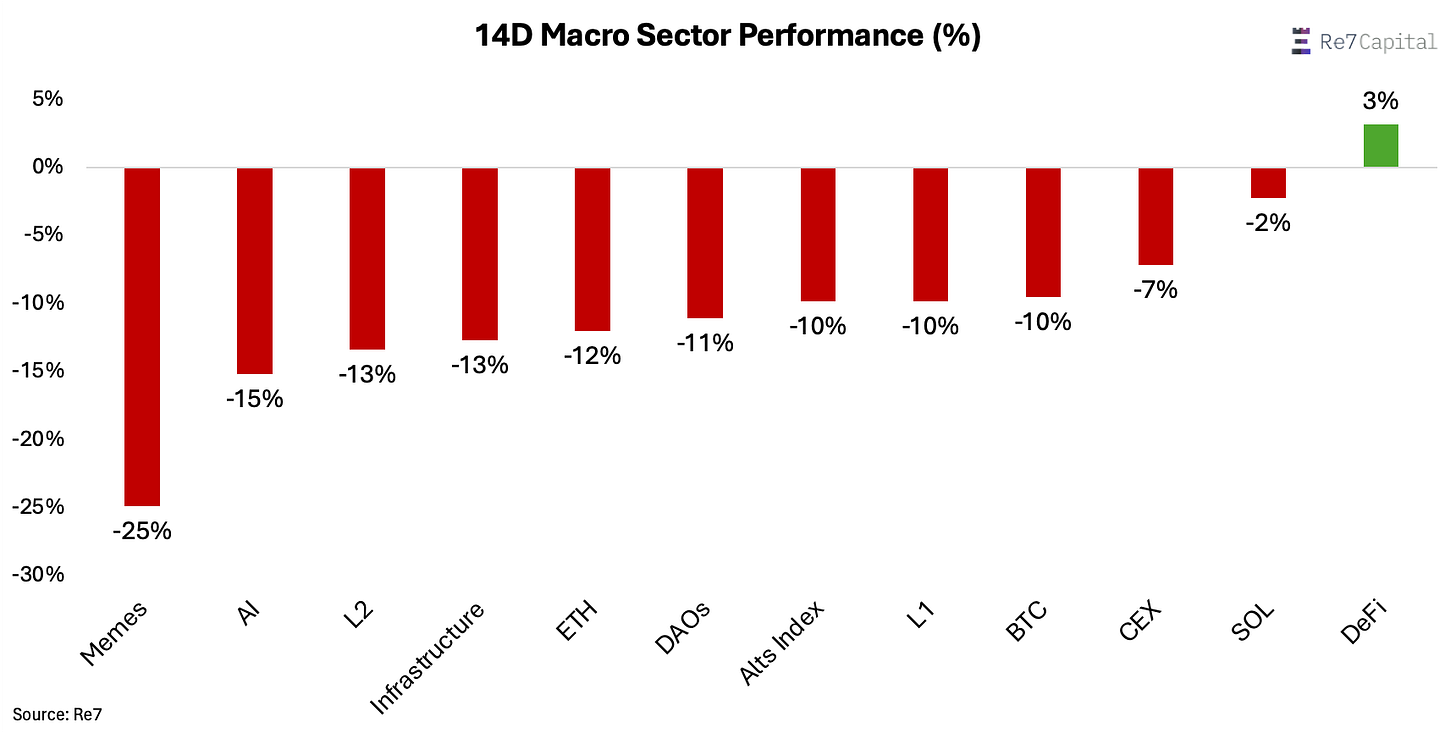
This has meant AI-centric themes within crypto have been the worst relative performers in the last two weeks with orthogonal themes (e.g. DeFi being the only positive sector nominally in the same time period).
With compute increasingly underpinning economic activity, semiconductor sales have become a useful leading indicator for broader capex trends.
Historically, investment, hiring and economic activity have followed where chip demand leads.
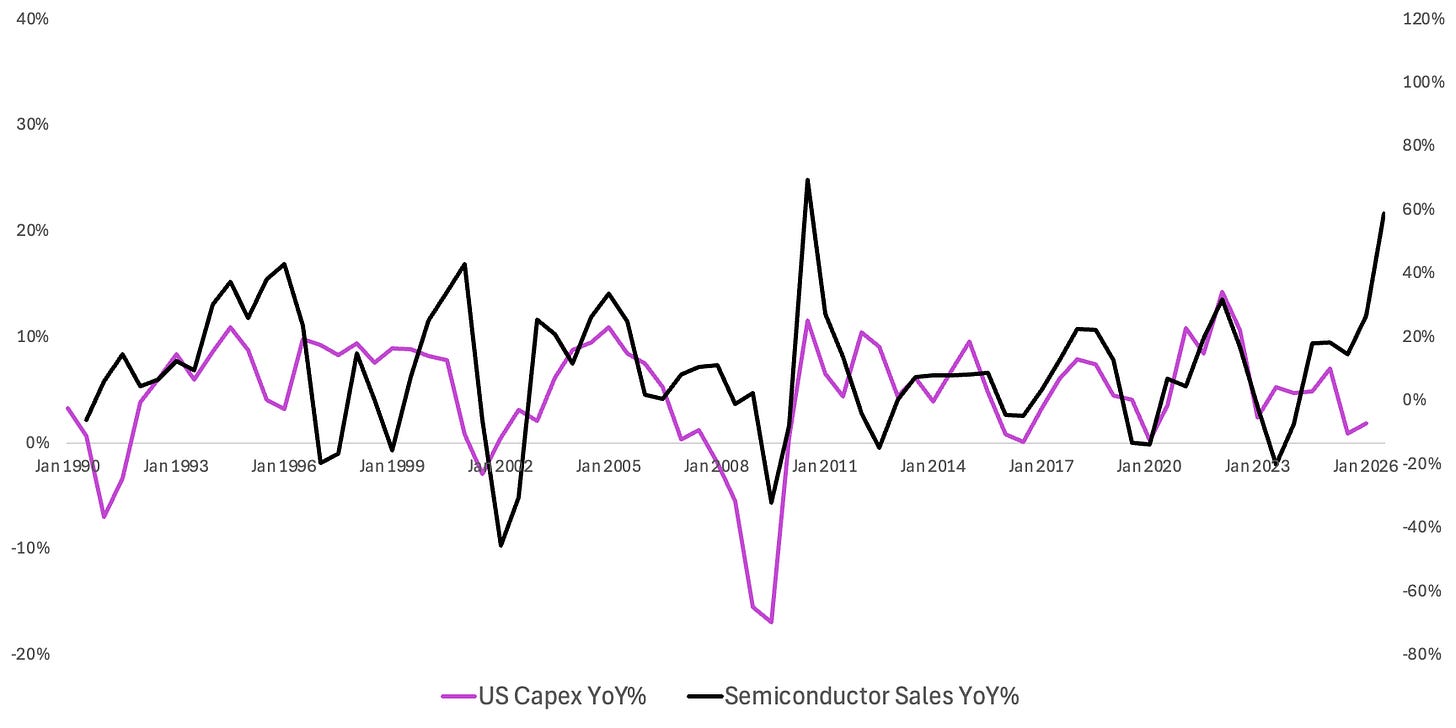
The recent surge in semiconductor sales suggests business investment is more likely to reaccelerate than roll over, reinforcing the constructive signal from improving liquidity conditions.
STRC
Over the past few weeks, Strategy’s STRC has been at the centre of market debate. Despite being structured to trade around its $100 issue price, the security has fallen materially below par.
At lower prices, investors can buy STRC at a discount and receive a higher effective yield. On paper, that should make the security more attractive. In practice, the discount reflects the market demanding more compensation for the underlying risk.
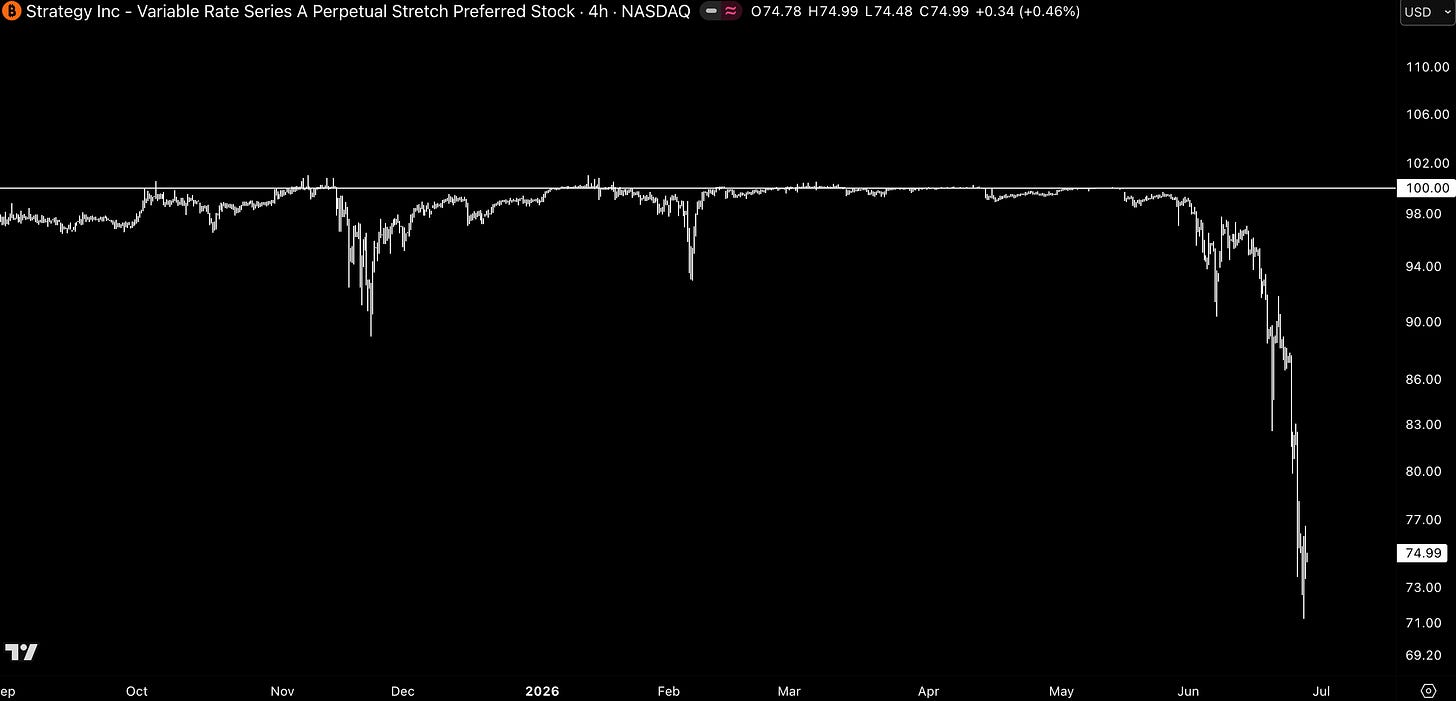
STRC/USD.
The reason is likely very simple: while STRC is marketed as an income product, investors increasingly view it as a credit instrument whose risk is closely tied to the price of Bitcoin.
Bitcoin’s price explains a significant portion of the variation in STRC’s credit spread. As Bitcoin falls, investors demand a higher spread over comparable Treasuries, pushing STRC’s price lower and its implied yield higher.
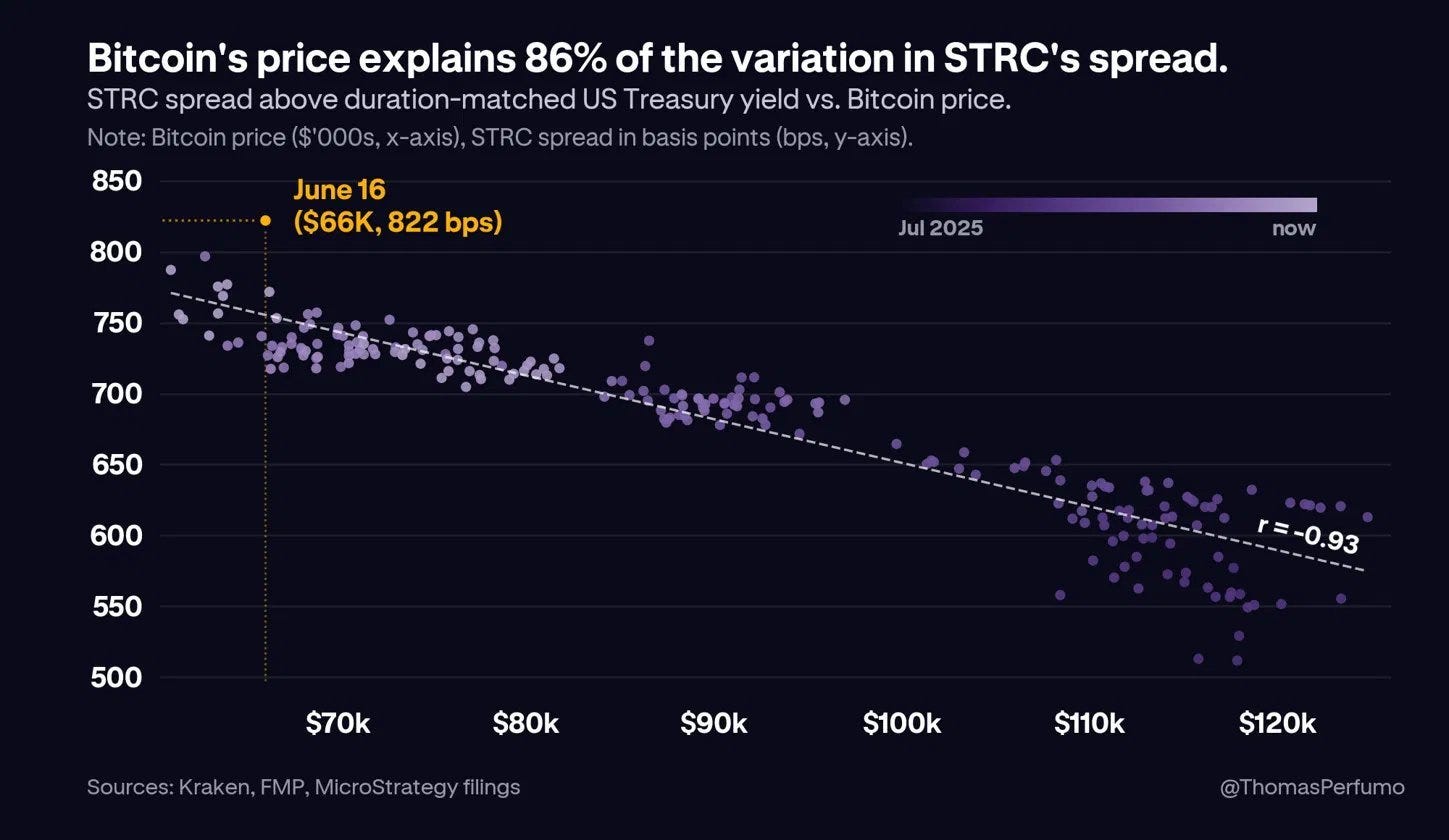
This is because Strategy’s ability to pay STRC dividends ultimately depends on a balance sheet dominated by Bitcoin, so when Bitcoin falls, investors worry the income stream is less secure and demand a higher return to hold it.
The takeaway is that STRC’s $100 target price is not a hard peg. It is a management objective, not a guaranteed floor. As long as Bitcoin remains the dominant driver of Strategy’s balance sheet risk, STRC will likely trade less like a stable income product and more like a junior Bitcoin credit instrument, driven by BTC’s direction and volatility.
RWA Perps
RWA perpetual futures have quietly become one of the fastest-growing segments in crypto derivatives. Weekly RWA perp volume has risen from less than $1 billion a year ago to ~$30 billion today, reflecting growing demand for synthetic exposure to traditional assets without leaving crypto-native venues.
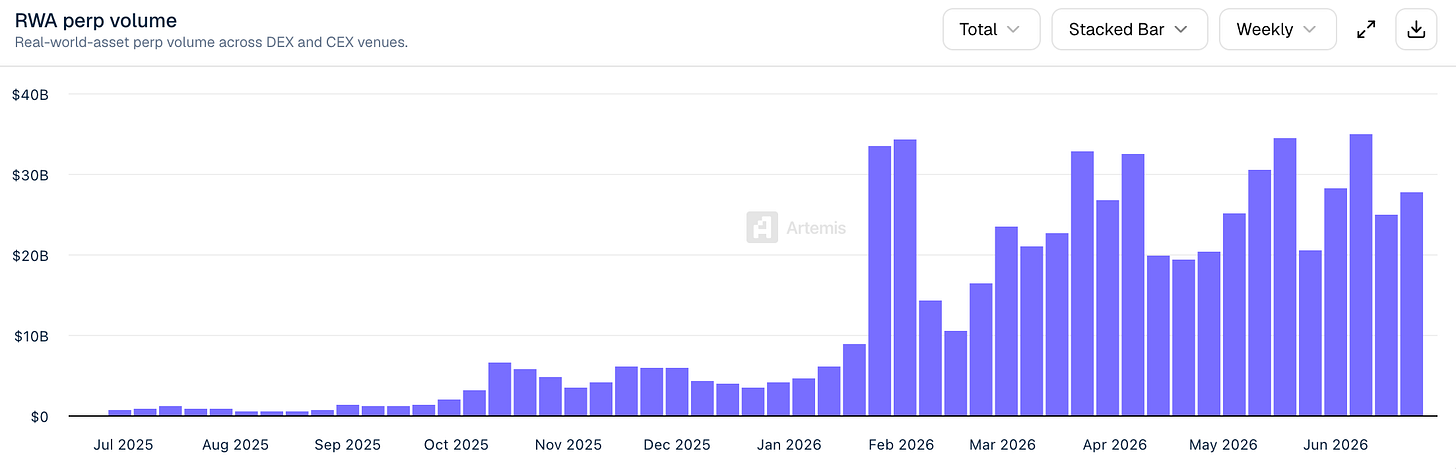
So far, that growth has been overwhelmingly driven by commodities.
Gold and silver accounted for over 70% of RWA perp volume last week, benefiting from strong price trends and elevated volatility throughout the past year.
However, this concentration is unlikely to persist as new RWA markets come online.
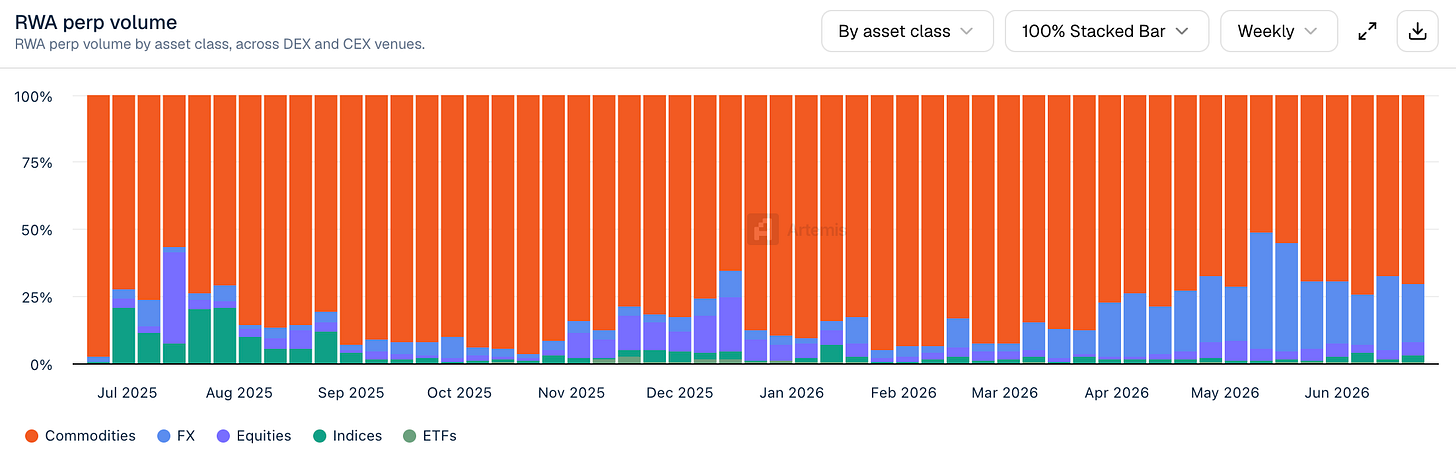
The next phase of growth is likely to come from equities. Integrations such as Hyperliquid's HIP-3 framework are making it easier for venues to list and distribute new markets, while a growing number of exchanges are exploring tokenised equities and equity-linked perpetuals.
As the product set expands, equity exposure could become a much larger share of RWA trading activity.
Despite rapid growth, RWA perpetuals still account for just 6.2% of total perp volume today, although they already represent roughly 27% of on-chain perp volume.
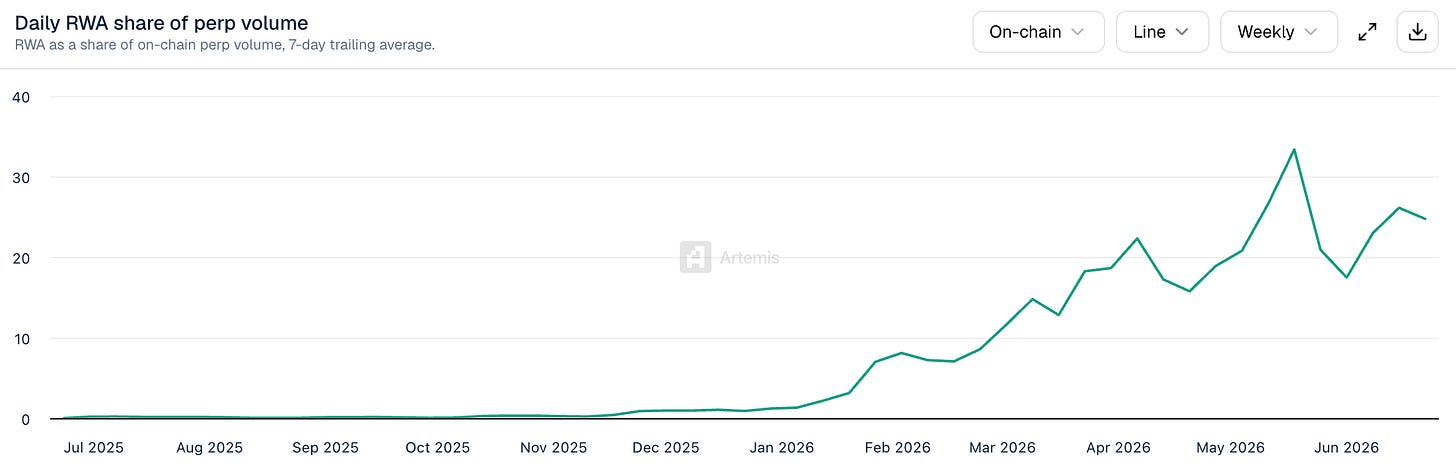
That on-chain share has room to expand further because RWA perps address a much larger opportunity set than crypto alone, spanning equities, commodities, FX and eventually other traditional asset classes.
Open interest is still only approximately $3.6 billion, suggesting the market remains early, with significant room for liquidity, capital formation and product breadth to grow.
State of Yields
Stablecoin lending yields:
~3.2% on Aave (USDC) — utilisation rates have come down slightly to 90%. No change in yield or utilisation rates from prior week.
~3.8% on Aave (USDe) — utilisation at ~57%. Slightly lower utilisation vs. last week.
Fixed-rate DeFi lending: yield premium in fixed markets marginally expanding from last week:
Pendle sUSDAi: ~9.17% (July-Oct 2026 maturities)
sUSDe: ~4.34%
ETH yield benchmarks:
Lido staking: ~2.32% - no change from prior week.
About Re7
Re7 Capital is a research-driven digital asset investment firm specialising in DeFi yield and liquid alpha strategies.
Disclaimers
The content is for informational purposes only. None of the content is meant to be investment advice. Use your own discretion and independent decision regarding investments. The opinions expressed in all Re7 public research articles are the independent opinions of the authors at the time of publication and not the opinions of the affiliates of Re7.
Please see here for full disclaimers.