Weekly: What Happened Last Week?
FEB 9, 2026
In this week’s note, we break down one of the most mechanical selloffs the market has seen in years — examining how cross-asset deleveraging, ETF flows, and systematic risk management combined to create a six-sigma move in Bitcoin. We also look ahead to what consolidation and sentiment data suggest for the weeks to come.
Last week, we spoke with Crypto Insights Group as part of their What’s Working with Allocators feature, exploring how institutions are underwriting non-directional DeFi yield strategies, what’s resonating most through diligence and ongoing engagement, and how crypto fund structures — including crypto-denominated share classes — are evolving to meet institutional constraints.
Weekly Summary
Analysis of last week’s volatility drivers
Market update and the look ahead
What Happened Last Week?
Last week’s market selloff was unlike anything we’ve seen in a while—not just because of how violent it was, but because of what drove it.
The price action had Wall Street written all over it: multi-strategy hedge funds cutting risk across their entire portfolios, options traders forced to rebalance their positions, and various structured investments all hitting critical breaking points simultaneously.
What looked like mass selling was actually more mechanical — forced liquidations driven by risk management rules rather than genuine conviction-based selling. Bitcoin ETFs were likely at the centre of it all.
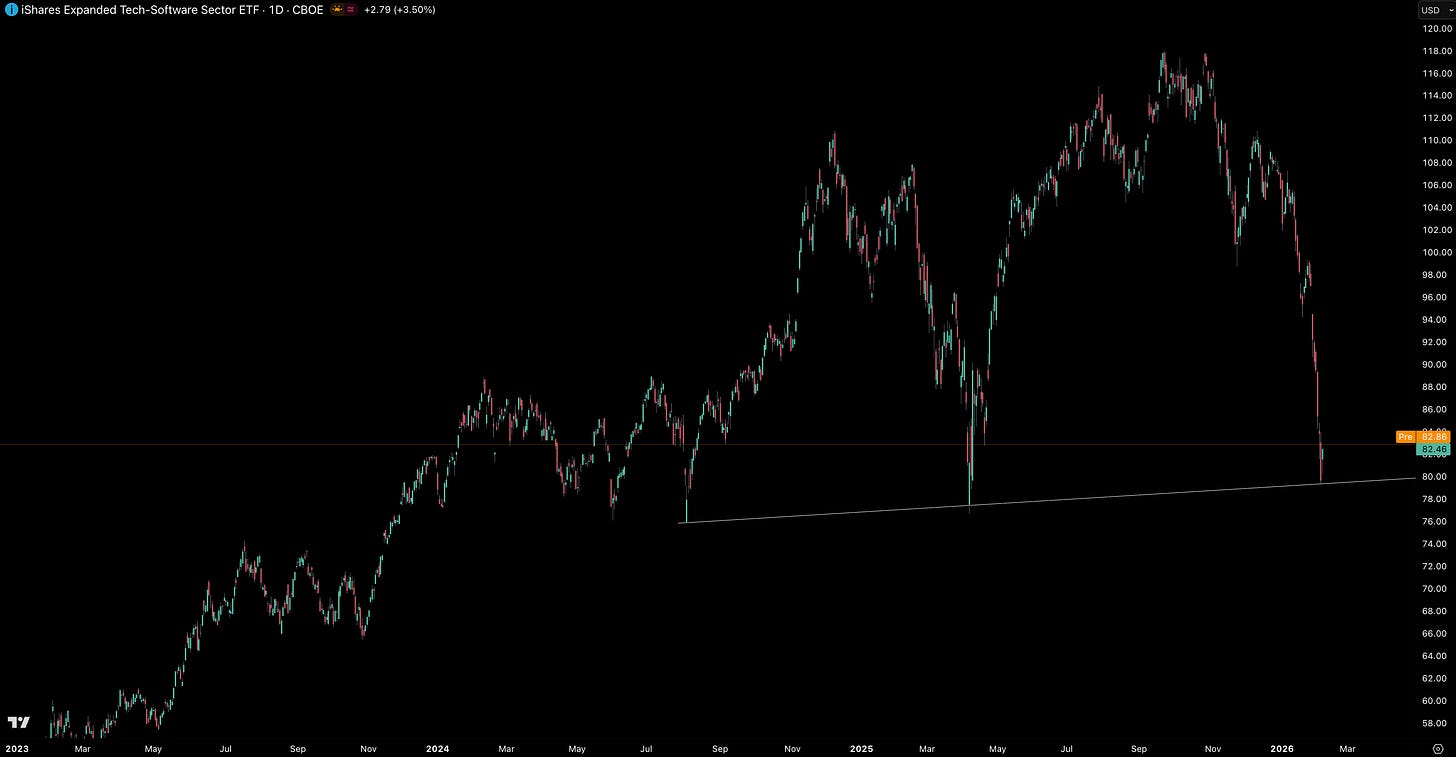
First, the catalyst was likely the software sector selloff, whose correlation with Bitcoin we've highlighted in previous newsletters.
As growth equities repriced lower, portfolio risk models forced cross-asset deleveraging, pulling capital out of correlated high-beta exposures — including Bitcoin.
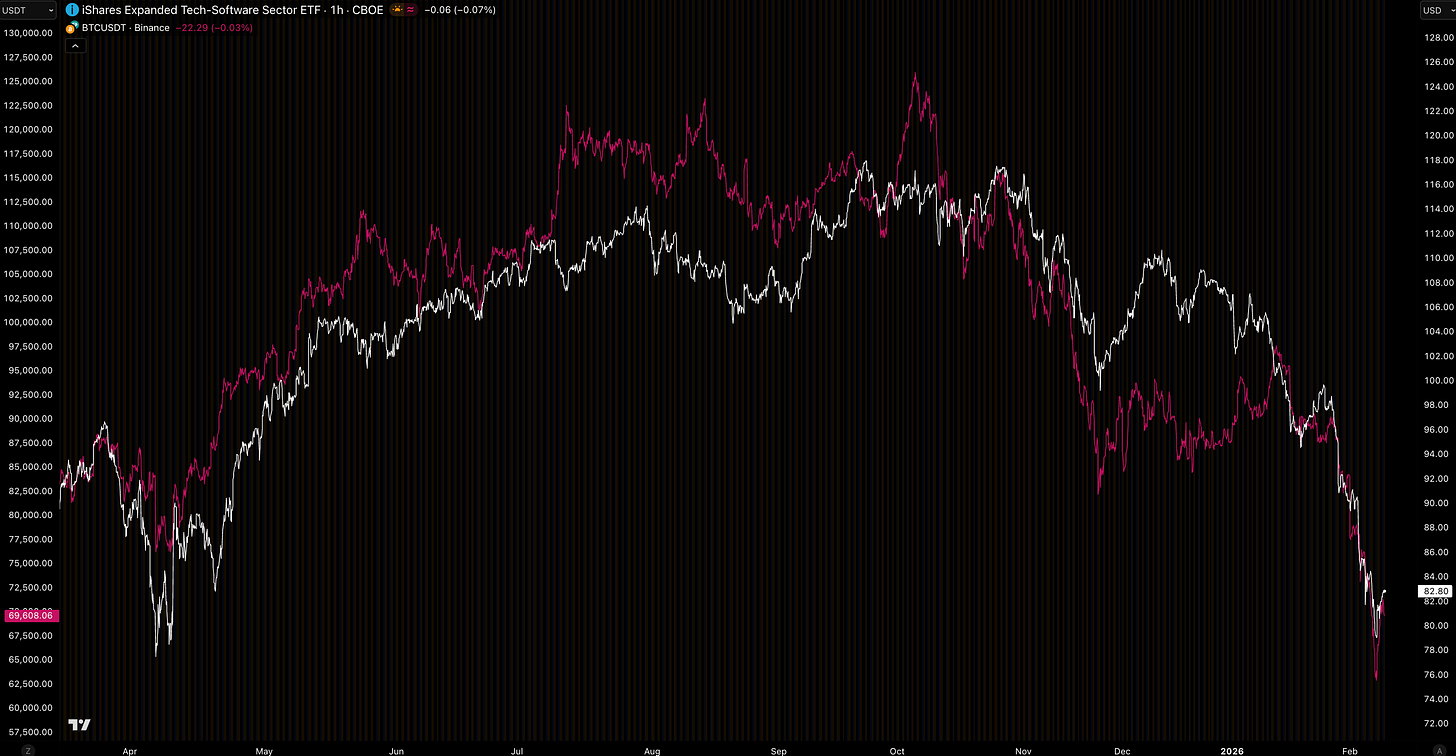
Second, what exacerbated price action was the mechanical feedback loop created by ETF flows, derivatives positioning, and systematic rebalancing.
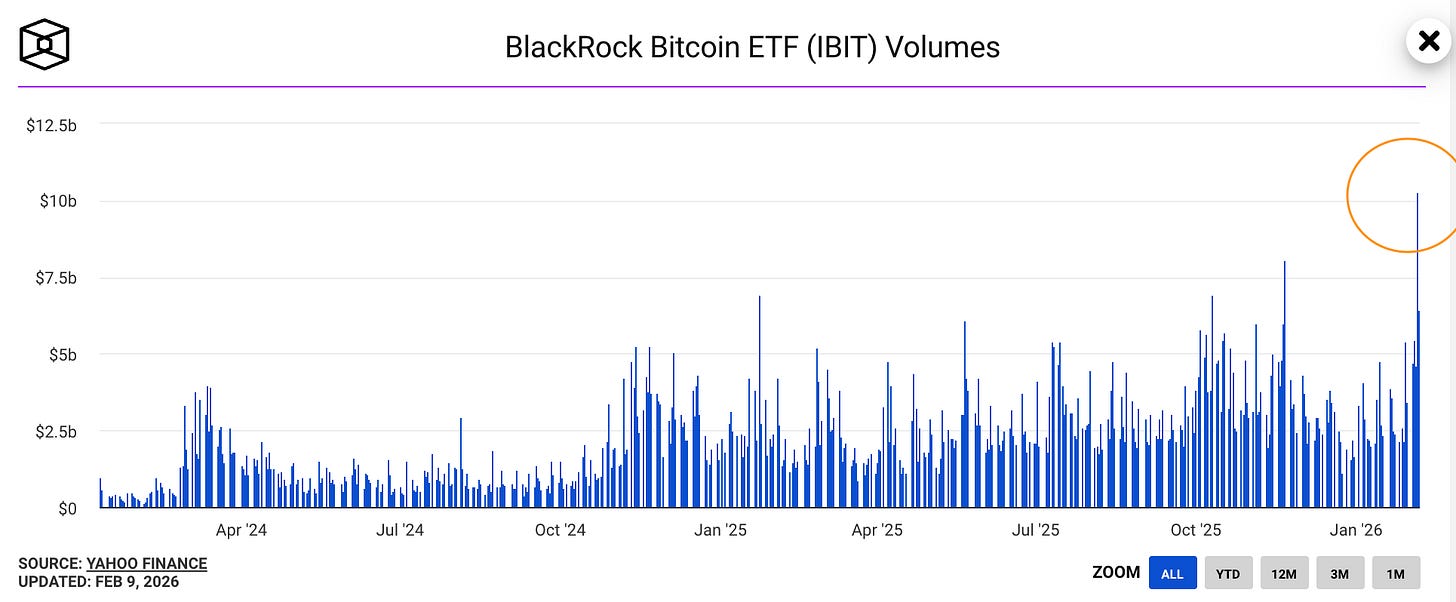
IBIT printed a record $10B in volume on the 5th of February.
US spot Bitcoin ETFs saw notable net inflows on two key technical days: $561m on February 2nd when BTC broke below $80k, and $371m on Friday after Bitcoin wicked down to $60k.
These inflows appeared to act more as absorptive liquidity than directional drivers, with derivatives-driven liquidations overwhelming spot demand in the short term.
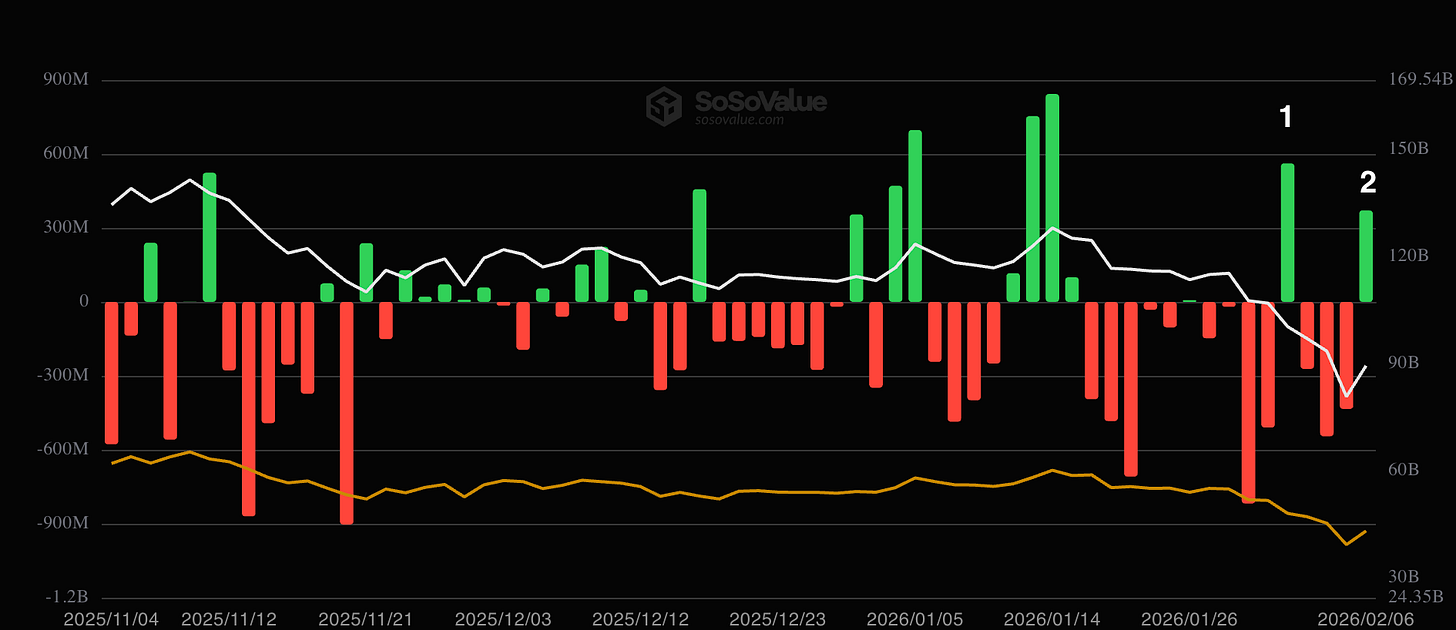
Both instances suggest opportunistic buying at significant technical levels—a major psychological support in the first case, and touching just above the 200-week moving average (a key long-term support level) in the second.
However, there is evidence that Friday’s inflows may have had an additional driver: market makers being forced to buy IBIT shares after becoming short gamma during Wednesday’s chaotic selloff, requiring rapid delta rebalancing as volatility expanded.
When prices plummet violently, these dealers—who hedge options positions—struggle to keep pace and often overshoot, requiring them to buy back shares days later regardless of market sentiment.
This combination of strategic dip-buying and mechanical rebalancing explains the unexpected inflows during what many assumed would be a period of mass redemptions.
Market Outcomes
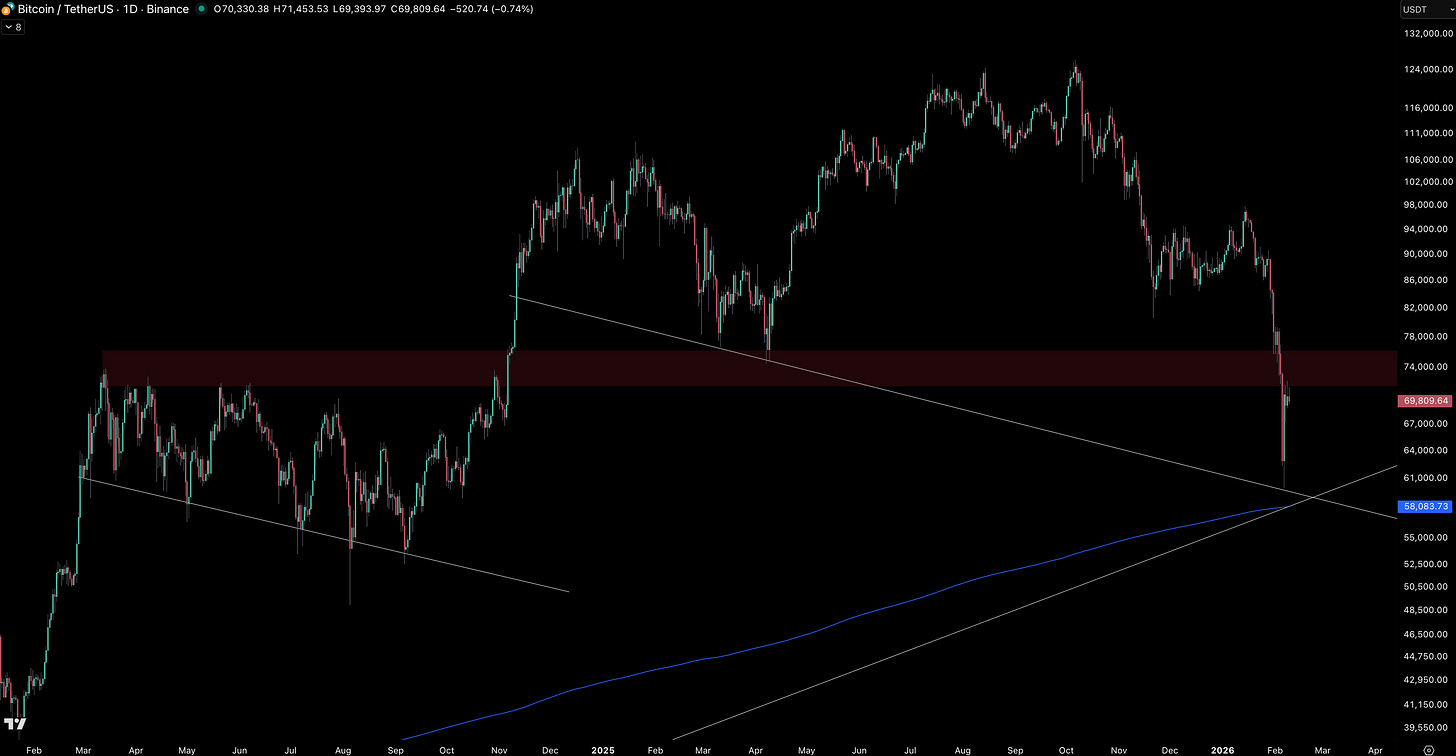
Global crypto market capitalisation fell 10%, wicking down to its 200W MA where buyers started stepping in more forcefully.
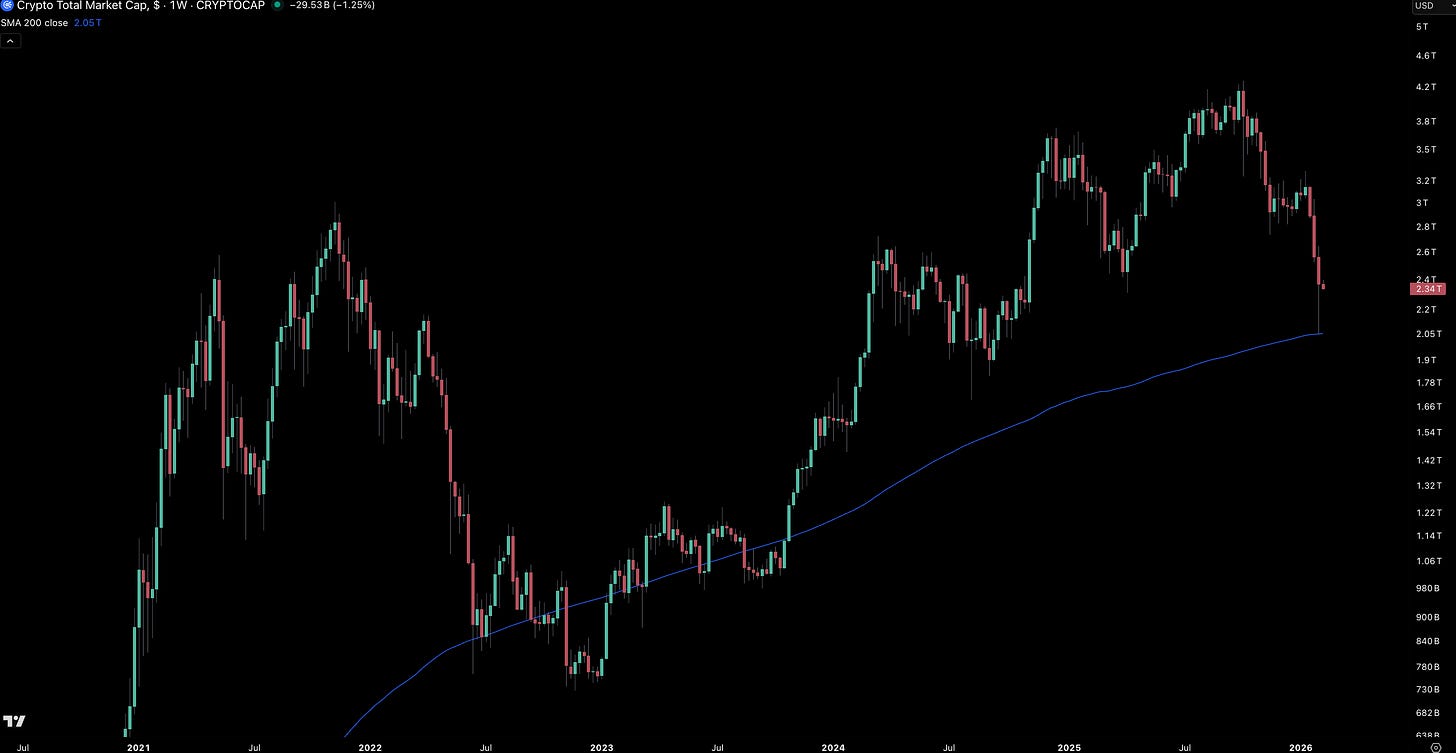
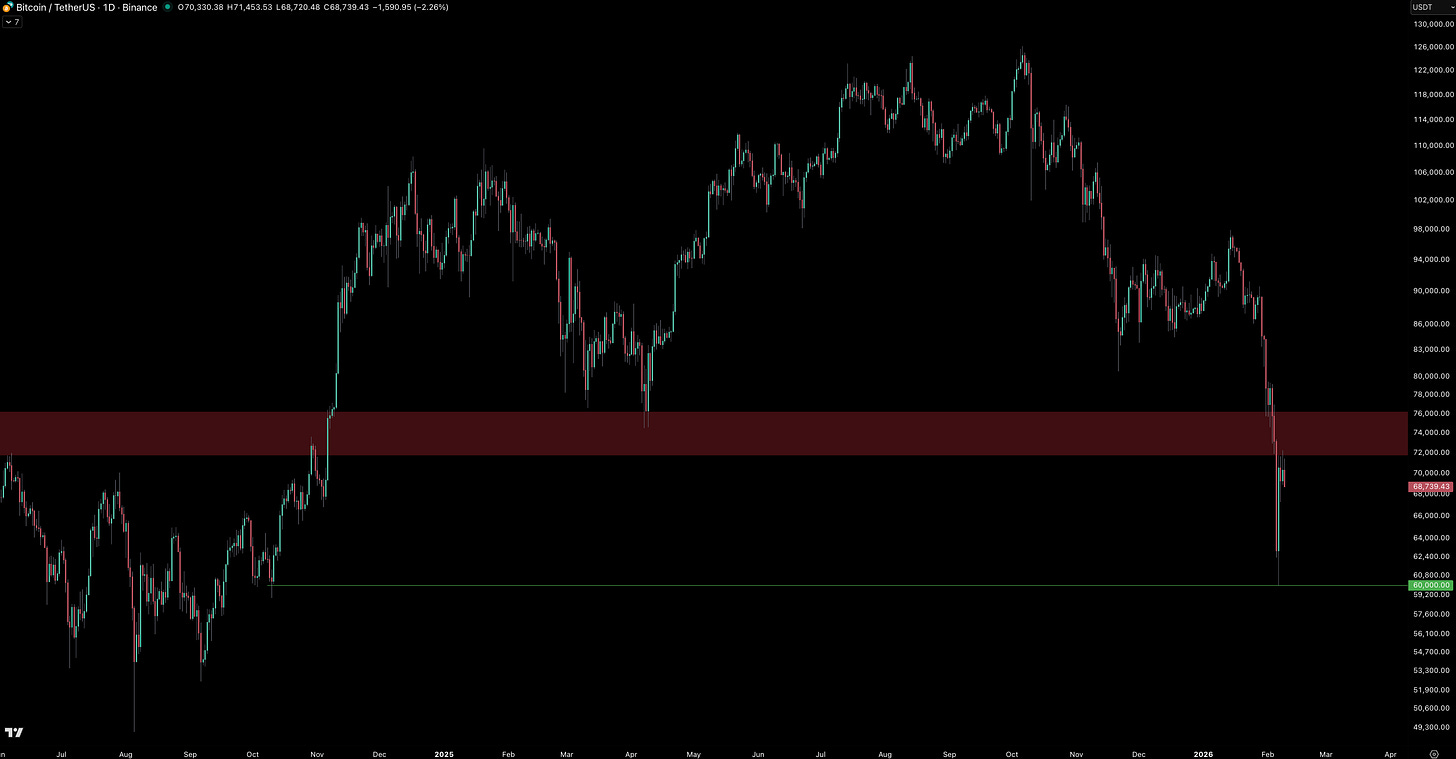
BTC wicked down to exactly $60,000, where buyers stepped in just before reaching a cluster of key support levels: the 200-week moving average, the 8-year support trend line, and the 2024 support line.
BTC was the most oversold since COVID crash in March, 2020.
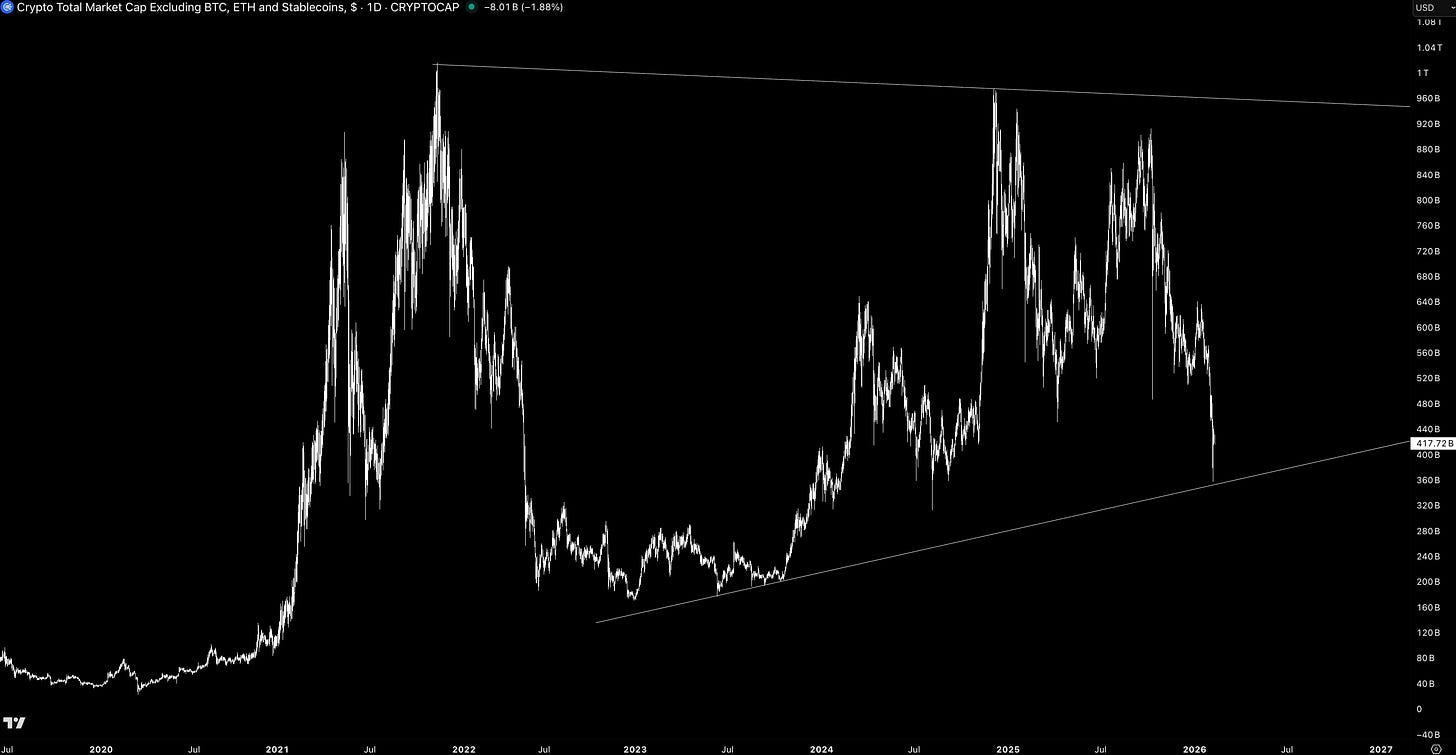
Meanwhile global market capitalisation (excl. BTC, ETH, and stablecoins) wicked down to bull market support before re-bounding +23%.
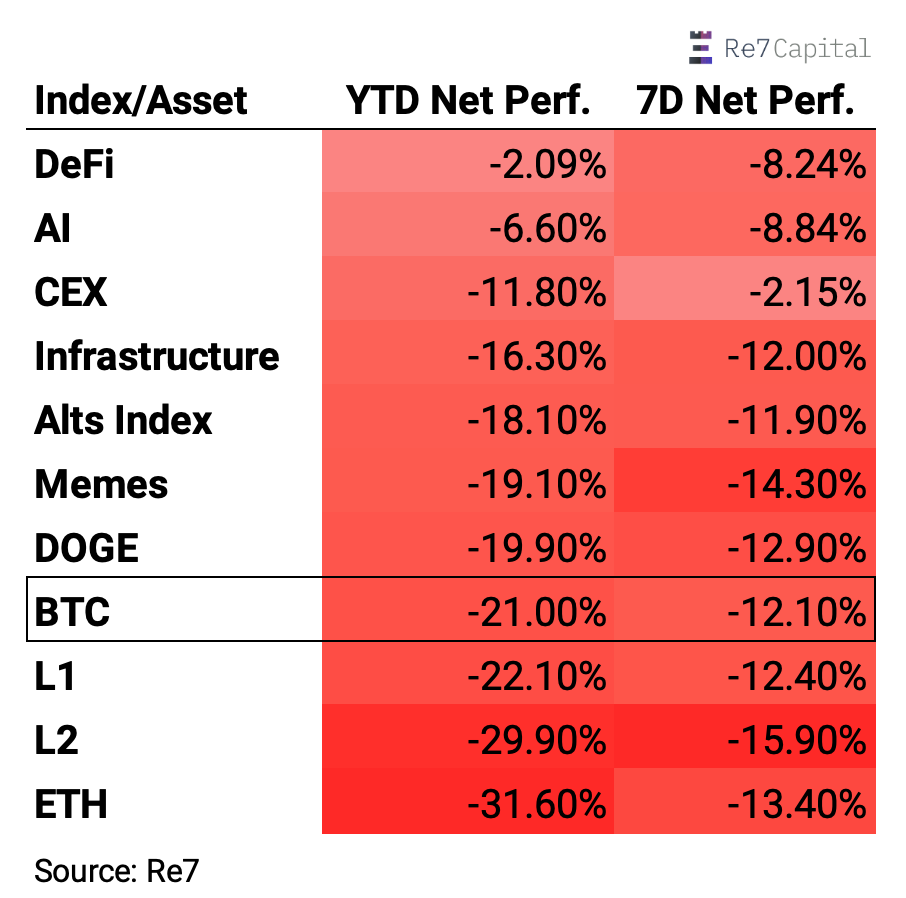
In fact, alt sectors have generally outperformed BTC year-to-date and during the recent selloff, further supporting the idea of structural selling pressure around Bitcoin, although alts were not immune to the move directionally.
Last week’s relentless downside move registered a -6.4 sigma move relative to historical daily volatility — a statistical measure showing the move was over six standard deviations beyond normal.
This level of downside volatility had not been seen since March 2020 and signals the move was structural rather than fundamental.
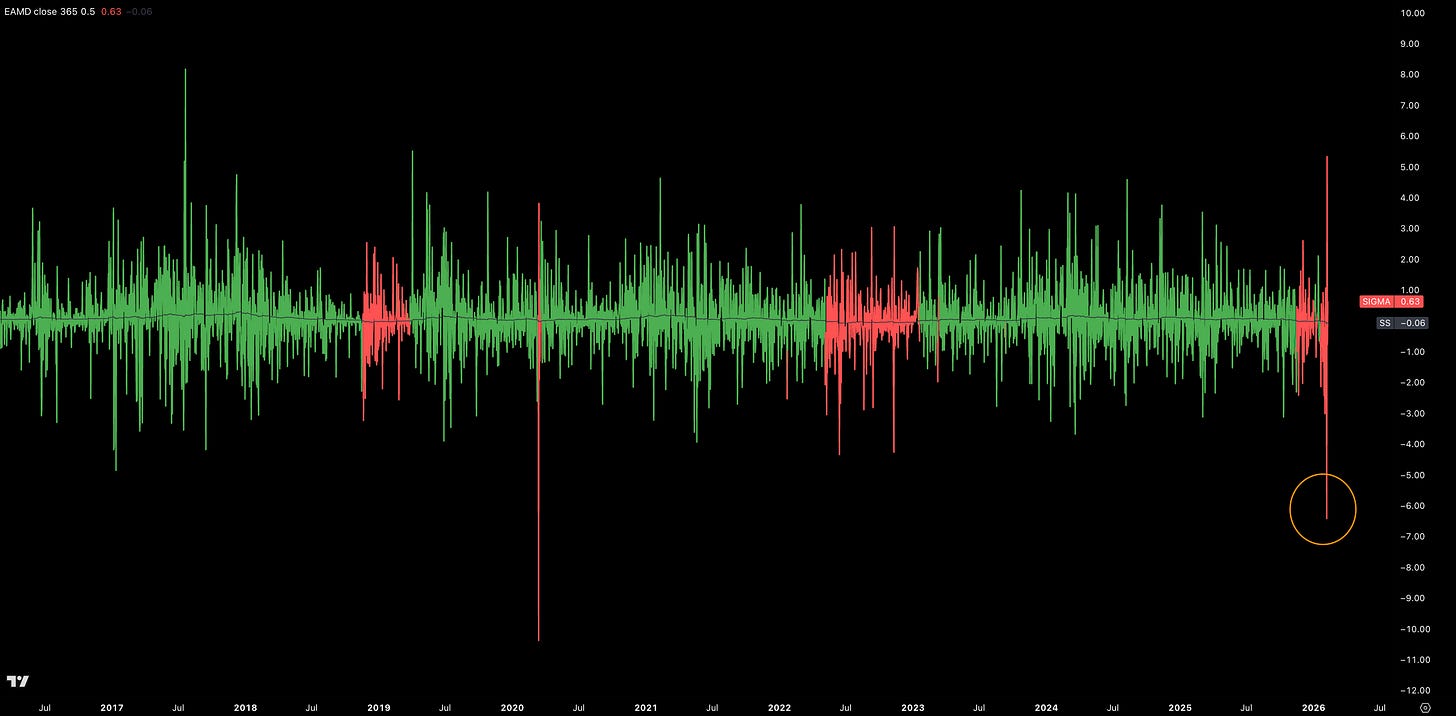
BTC/USD exponential moving average of (sigma) delta.
Market sentiment, an index which was already in deeply fearful territory marked a new all-time-low of 5 on Thursday.
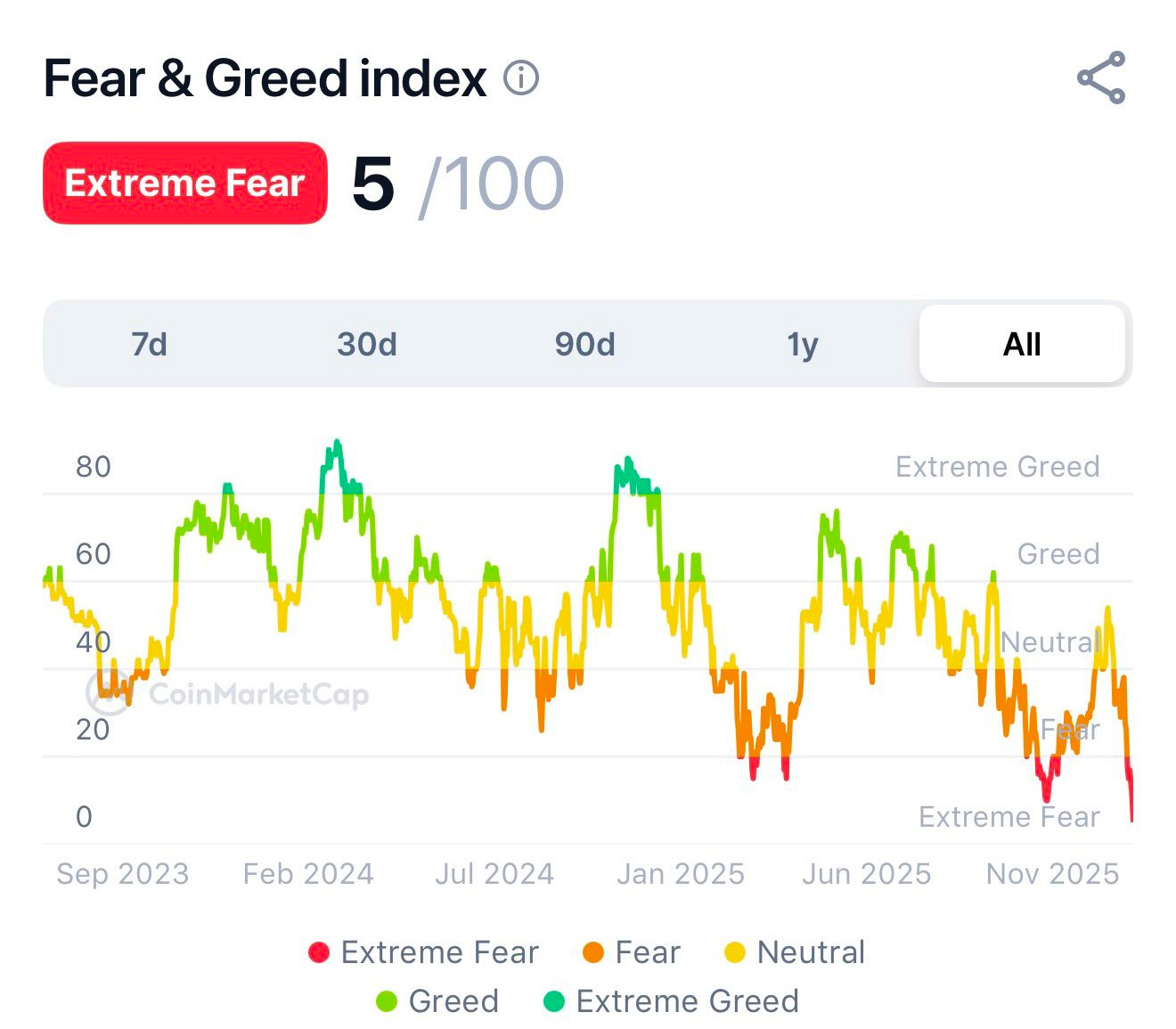
Extreme sentiment readings often coincide with mechanical liquidations rather than purely fundamental repricing.
The Look Ahead
The markets are likely going to be in digestion mode with a reasonable possibility of re-testing last week’s lows (allowing divergences to form). After all, moves like these are rarely v-shape recoveries in the short run.
Fear & Greed Index remaining at 14 despite the initial rebound suggests investors are still hesitant to go long beyond short-term bounce trades from $60k.
We can see this reflected in the chart as well, with price repeatedly selling off near $72k — the lower boundary of the range between previous cycle highs and the April 2025 lows.
Technology may also be in its own digestion mode for the next few weeks. Stabilisation in growth equities will likely be important for sustained recovery in crypto.
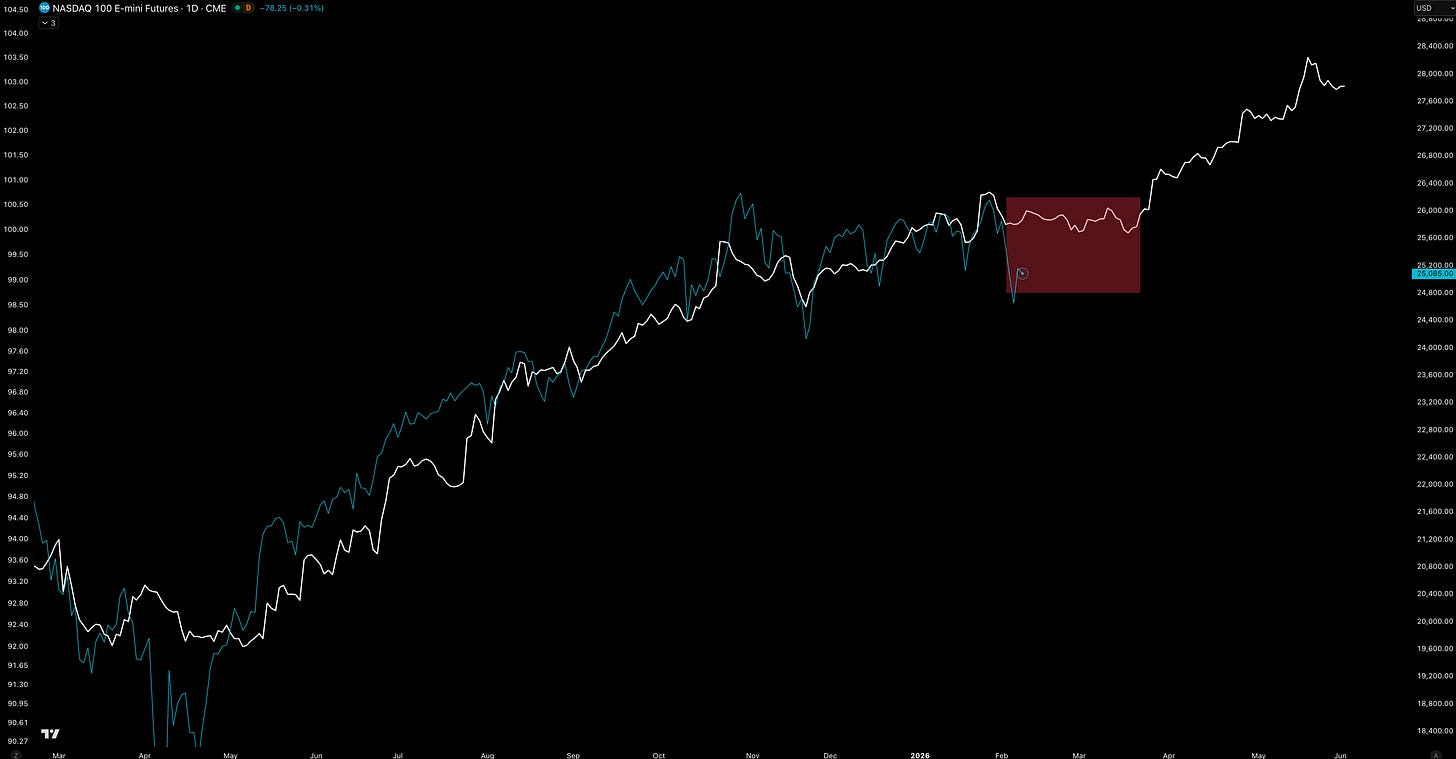
NASDAQ vs. Global Net Liquidity (10W lead).
On the positive side, software may be entering a bottoming phase, with the IGV index reaching its most oversold level on record.
That said, a more meaningful expansion in US liquidity conditions will likely be required before growth assets can regain sustained upside momentum.
Closing Remarks
Last week’s volatility underscored a key reality of Bitcoin’s institutionalisation: legitimacy brings mechanical risks.
As Bitcoin becomes embedded in cross-asset portfolios, price moves are increasingly driven by deleveraging, hedging flows, and risk models rather than fundamentals.
Institutional participation adds long-term demand and scale, but also ties Bitcoin more closely to TradFi dynamics during periods of stress.
The trade-off is clear: greater permanence comes with the fragilities of leverage, correlations, and mechanical selling. The path to reserve-asset status runs through Wall Street’s plumbing — for better and worse.
About Re7
Re7 Capital is a research-driven digital asset investment firm specialising in DeFi yield and liquid alpha strategies.
We’re Hiring for multiple highly impactful positions, including Chief of Staff and Head of Legal. If you’re excited by institutional DeFi and want to help shape its future, you can explore these position, and others here.
Disclaimers
The content is for informational purposes only. None of the content is meant to be investment advice. Use your own discretion and independent decision regarding investments. The opinions expressed in all Re7 public research articles are the independent opinions of the authors at the time of publication and not the opinions of the affiliates of Re7.
Please see here for full disclaimers.