Weekly: DeFi Growth Through a Macro Lens
MAR 30, 2026
This week’s note explores the growing divergence between DeFi fundamentals and valuations through a macro lens. Focusing on Aave as a case study, it highlights how lending revenue mechanics respond to broader market cycles and why current conditions could drive renewed protocol growth. The update also covers crypto market stability despite geopolitical uncertainty, shifting yield dynamics across DeFi and TradFi, and Re7’s latest hiring and research initiatives.
Last week, Momentum continues to build around Telegram’s in-app wallet, where users have now been earning yield on USDT holdings for several weeks. Opportunities of up to 18% powered by Re7 Labs are driving the next phase of mainstream crypto adoption, combining simple access with institutional-grade yield strategies.
Re7 Capital also continues to gain recognition across the industry awards circuit. The firm is shortlisted for Risk-Adjusted Returns of the Year at the Hedgeweek® European Awards 2026, underscoring our focus on consistent, risk-aware performance across both digital assets and traditional markets. Re7 is also recognised across six categories at the Hedgeweek® Global Digital Assets Awards, including Discretionary Fund, Market Neutral Fund, and Multi-Strategy Fund.
Weekly Summary
We cover:
How Lending sector generates revenue
Double clicking on AAVE as a case study
The three variables that drive revenue
Why the current macro cycle is a tailwind for all three
Market update
DeFi Growth Through a Macro Lens
Sector-Level Divergences
We’ve highlighted before the divergence between fundamentals and valuations across various sectors, including Lending.
For example, today, we’re seeing the largest divergence between sector-wide active loans and fully-diluted valuations.
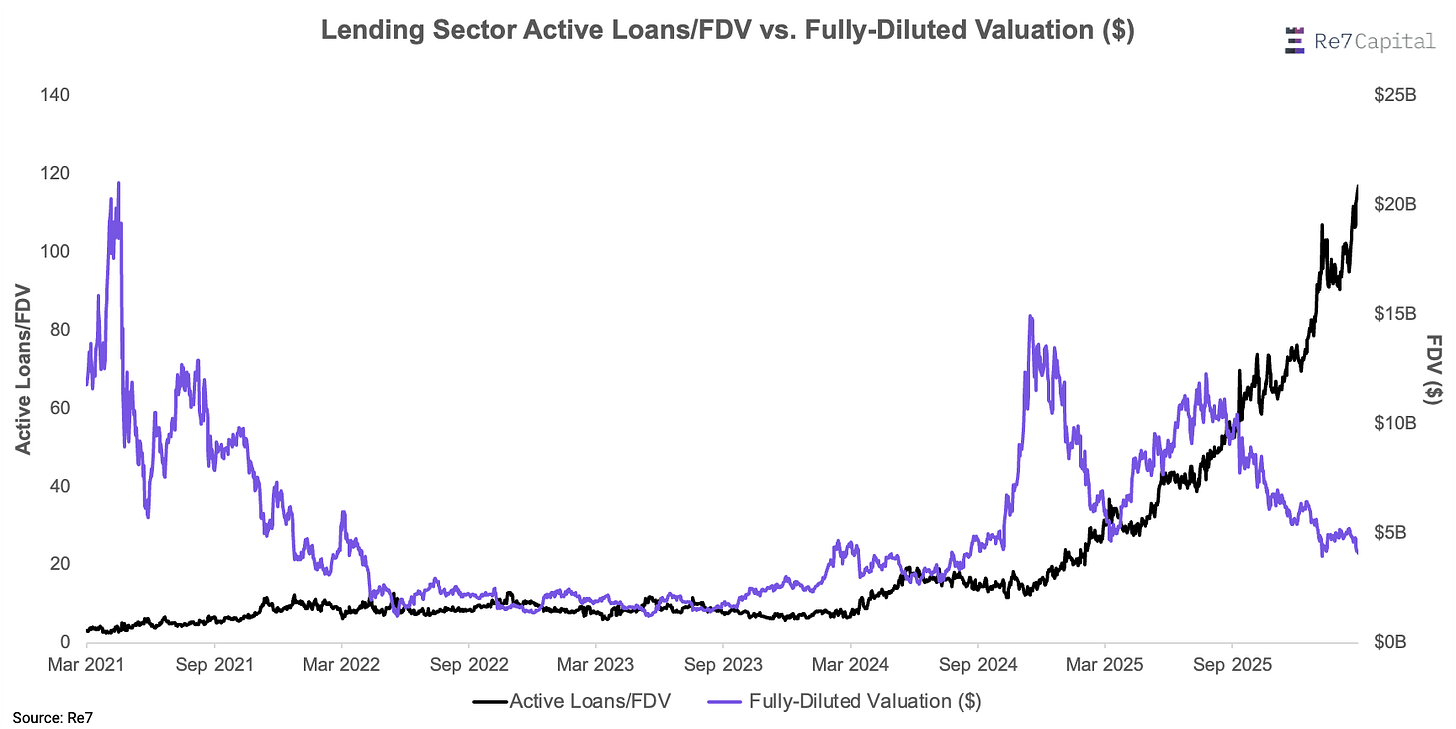
If we look at specific example within Lending such as AAVE, its revenue and upside potential is contingent a variety of mechanisms which respond differently to where we are in the broader market cycle.
How Aave makes money
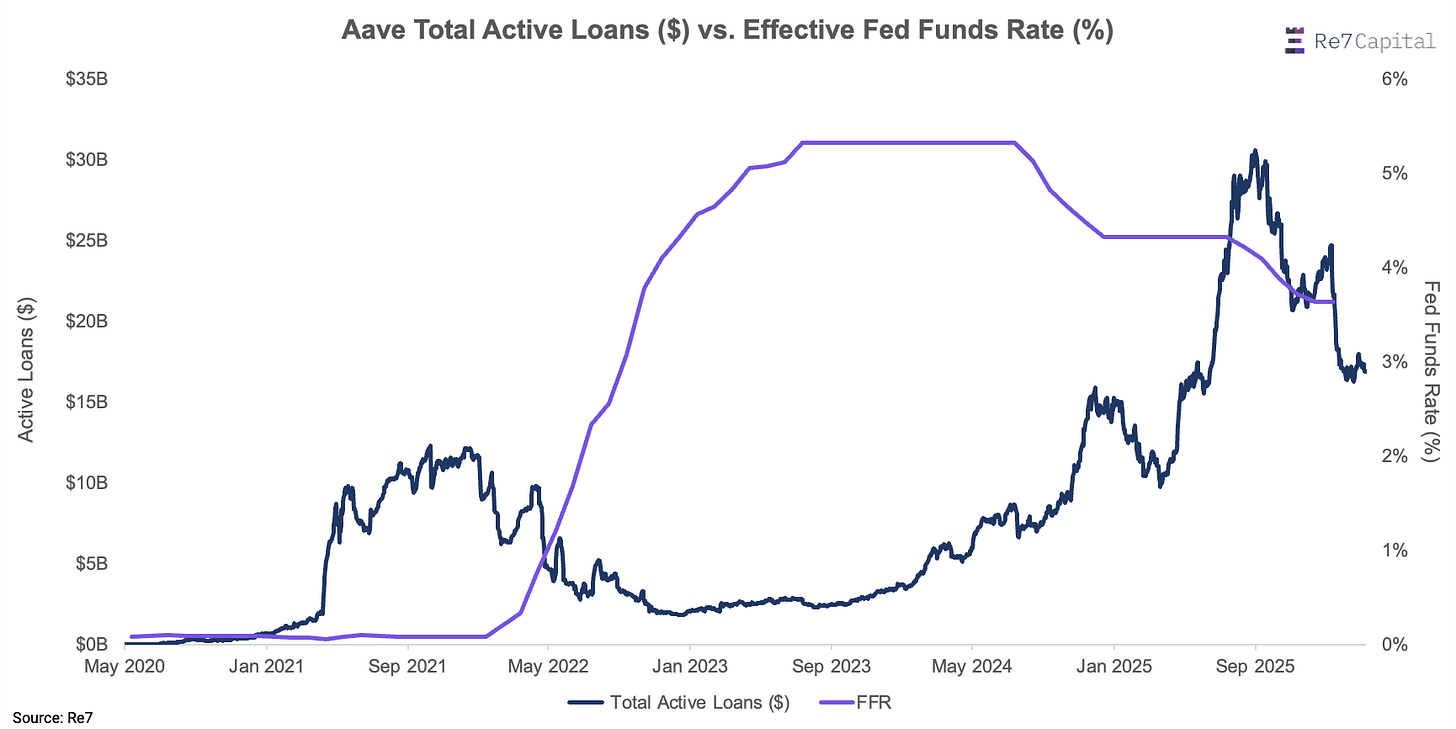
Aave’s revenue is essentially a function of three things: borrow volume, the prevailing interest rate environment, and the share of interest that accrues to the protocol treasury. In a higher-yield, wider-spread environment, all three move up simultaneously.
In a tightening cycle, the reverse is true — as we saw clearly when the Fed hiked aggressively from 2022, Aave’s active loan volume fell sharply, and has only recently begun to recover as rates have come off their peak.
Why the Current Environment is Interesting
Three variables do most of the heavy lifting in driving Aave’s revenue:
Borrow volume: the primary revenue driver. Historically, the bulk of active loan growth has occurred after ISM crosses 50 — a threshold we have recently passed. 93% of last cycle’s loan growth came after that point.
Borrow rates: currently averaging around 3.5% blended across markets. At prior cycle peaks, blended rates reached 10–15% — a difference that flows directly into protocol revenue.
Valuation multiple: Aave currently trades at around 20x price-to-revenue. At prior cycle peaks, that multiple has exceeded 40x as risk appetite and confidence in forward earnings increases.
In a conservative scenario, where only borrow volume recovers, the revenue impact is meaningful on its own. In a more constructive environment — where all three variables move together — the combined effect has historically been a factor of 10x or more from trough to peak.
Broader Implications
DeFi applications can have clear and measurable revenue models that are directly leveraged to the macro and credit cycle conditions that appear to be turning. This thinking extends beyond lending — protocols sitting at the centre of on-chain credit, trading, and derivatives activity all stand to benefit as borrow demand, volumes, and risk appetite return.
Market Update
Global market capitalisation has been finding good support at $2.25T where the market has been unable to sustain a breakdown in technicals since the Middle East conflict began.
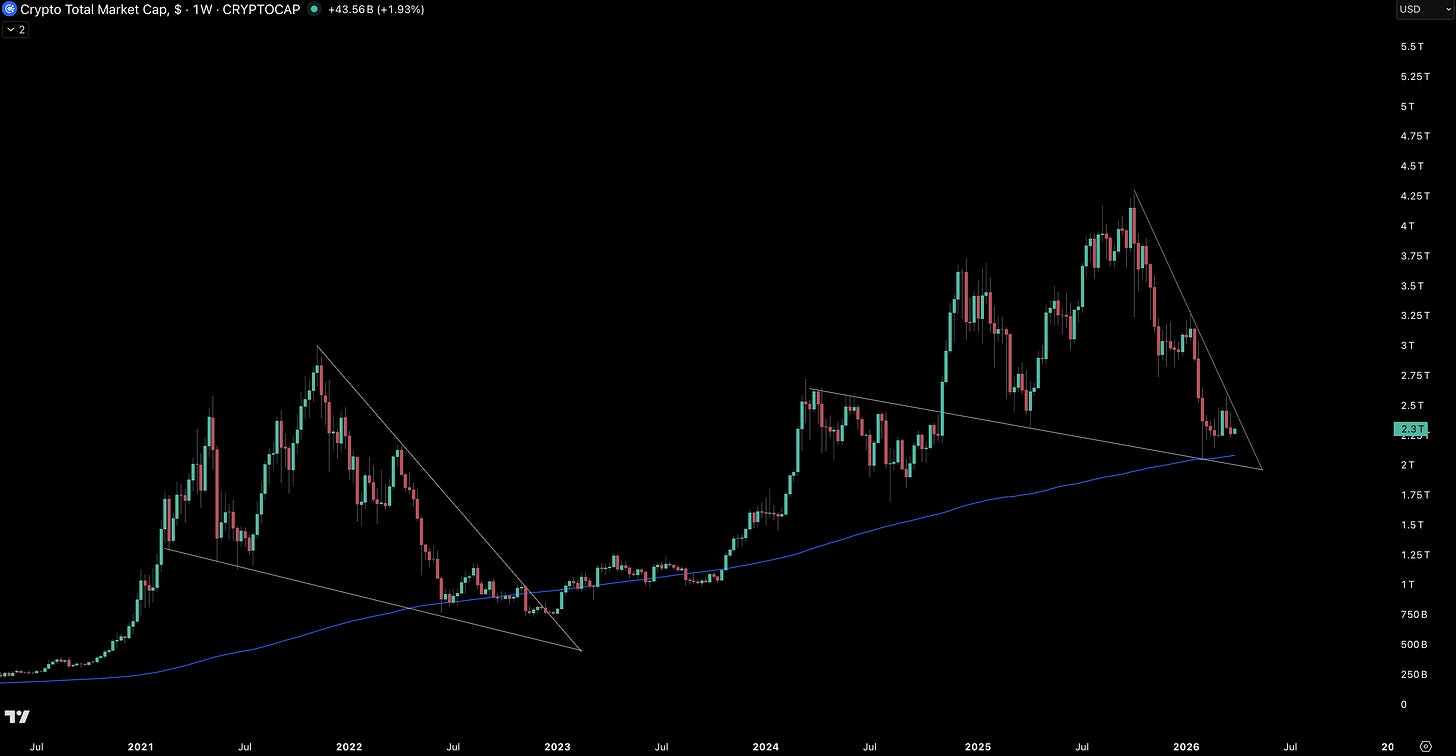
Global Crypto Market Capitalisation (weekly).
For BTC, we’ve seen 5 weeks of weekly closes >$65k.
So far, this week appears to be no different (+2%). Contrary to many expectations, BTC is finding some stability at these mid-60 levels despite ongoing headlines of escalation including ground troop operations by the US.
The BTC/Gold and Crypto/QQQ ratios, which bottomed on the weekend when the conflict started, are up +18% and +10%, respectively.
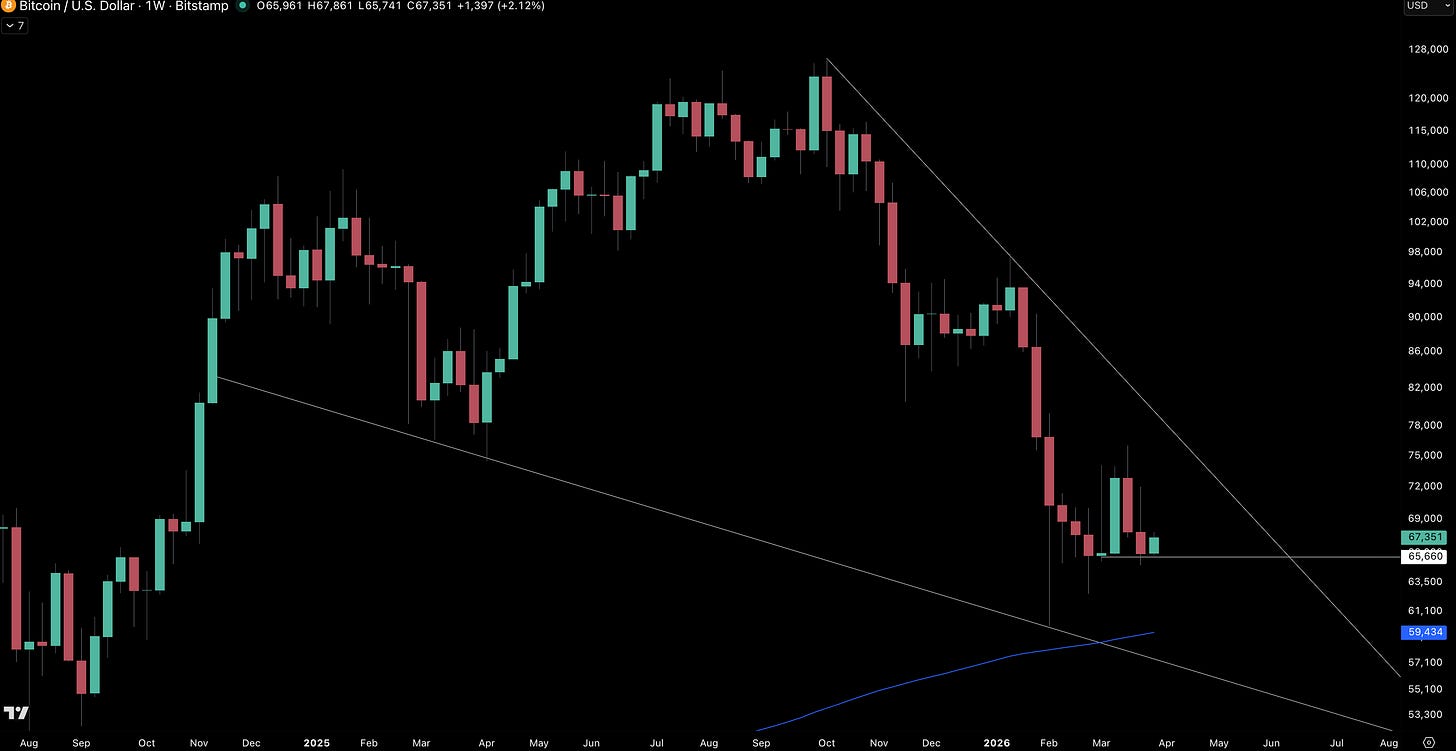
BTC/USD (weekly).
BTC/Brent Crude ratio has been finding support at ~620 over the past 2 weeks.
BTC’s wick to <$65k late Sunday drove the ratio to briefly dip below this level before strongly re-bounding back above this support in <1 hour.
Either a sustained break below these levels would signal the market placing further pressure on long duration assets, or the lows are in and the risk/macro backdrop begins to stabilise.
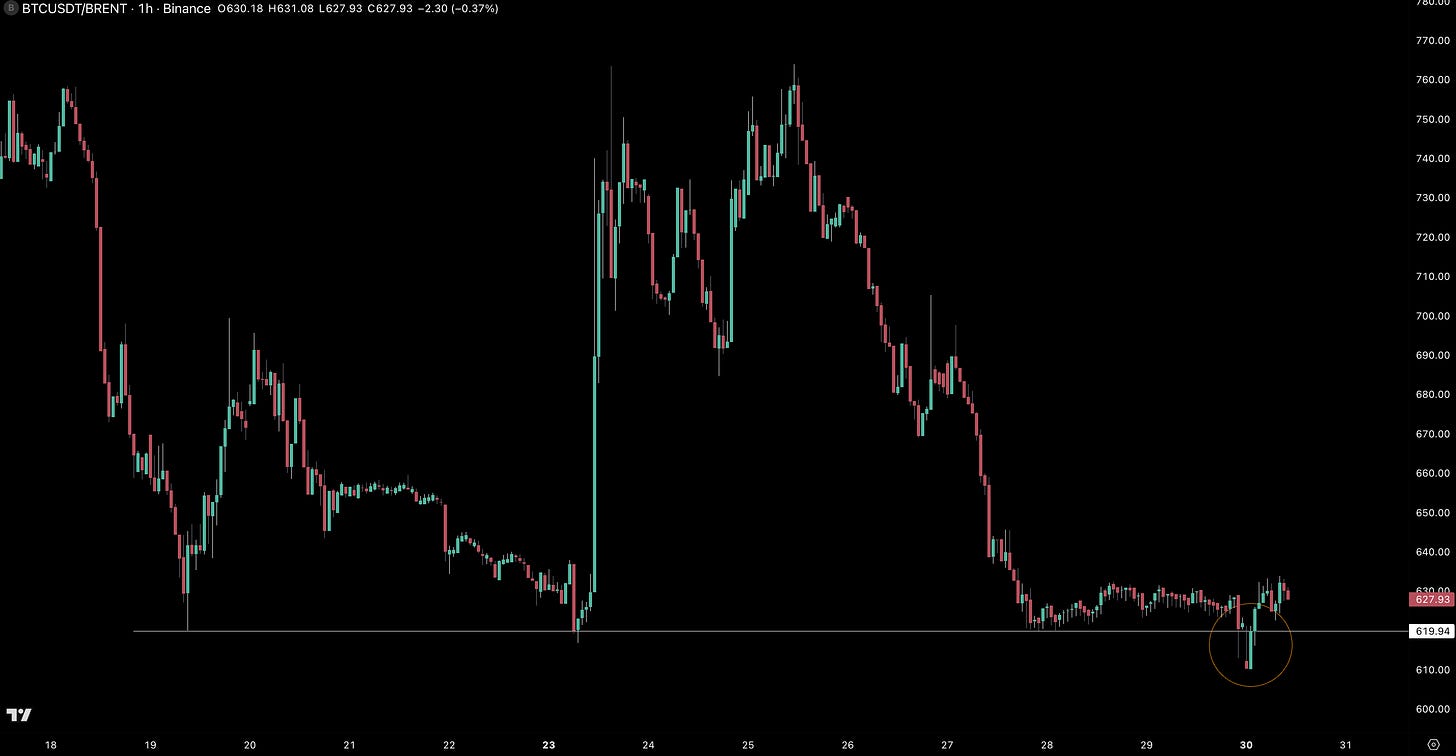
BTC/Brent Crude ratio (hourly).
What feels more clear is market conviction will continue to turn quickly — geopolitical developments, macro data, or a shift in liquidity conditions can reprice risk assets sharply in either direction and volatility will remain elevated.
State of the Yields
Stablecoin lending yields:
~2.18% on Aave (USDC), still below the ~3.7% 3-month T-bill rate. Variable-rate premiums remain compressed.
Fixed-rate DeFi lending: yield premium in fixed markets marginally expanding from last week:
Pendle sNUSD: 8.9% (Jun 2026)
Pendle sUSDAi: 7.4% (Jun-Oct 2026 maturities)
Pendle stUSDS: 5.7% (Jun 2026)
sUSDe holding: ~4.7%, up from ~3.5% last week
ETH yield benchmarks:
Lido staking: ~2.38% (down from 2.5%)
Disclaimers
The content is for informational purposes only. None of the content is meant to be investment advice. Use your own discretion and independent decision regarding investments. The opinions expressed in all Re7 public research articles are the independent opinions of the authors at the time of publication and not the opinions of the affiliates of Re7.
Please see here for full disclaimers.