Weekly, State of Play: Perpetuals
APR 6, 2026
Perpetual DEXs are reshaping crypto markets. On-chain derivative volumes have doubled year-on-year to 20% of total trading, led by Hyperliquid’s 40% share. With perps now trading 4.6x spot volumes, smart capital is moving on-chain for better fees, resilience, and composability. BTC stays firm despite geopolitical tension, while tokenised real-world assets surpass $28B, driven by treasury-backed products like Circle’s USYC fund, up 60% YTD.

Stay informed about what matters in crypto. Forget the noise. Get free market-leading crypto research by subscribing to Re7 Capital’s research below:
Last week, Momentum around Telegram’s in-app wallet continues to accelerate, as more users discover the ease of earning passive yield on their USDT holdings directly within the app. Powered by Re7 Labs, yields of up to 18% remain available, fuelling the next wave of mainstream adoption by pairing one-tap access with institutional-grade yield strategies.
Weekly Summary
We cover:
The rate of perpetual volume growth vs. spot
The rate of DEX volume growth vs. CEXs
Perp DEX market shares
Why perp DEXs are winning
State of the Yields
State of Play: Perpetuals
Perpetual Momentum vs. Spot
Crypto derivatives have always been the tail that wags the dog. Perps in particular — perpetual futures with no expiry, funding rates that keep them anchored to spot — became the dominant trading instrument almost by accident.
They stayed that way because they suited how crypto traders actually operate: high leverage, fast in and out, no rolling costs.
Perp/spot monthly volume ratio is at all-time-high where perp volume is 4.6x that of spot ($3.5T+).
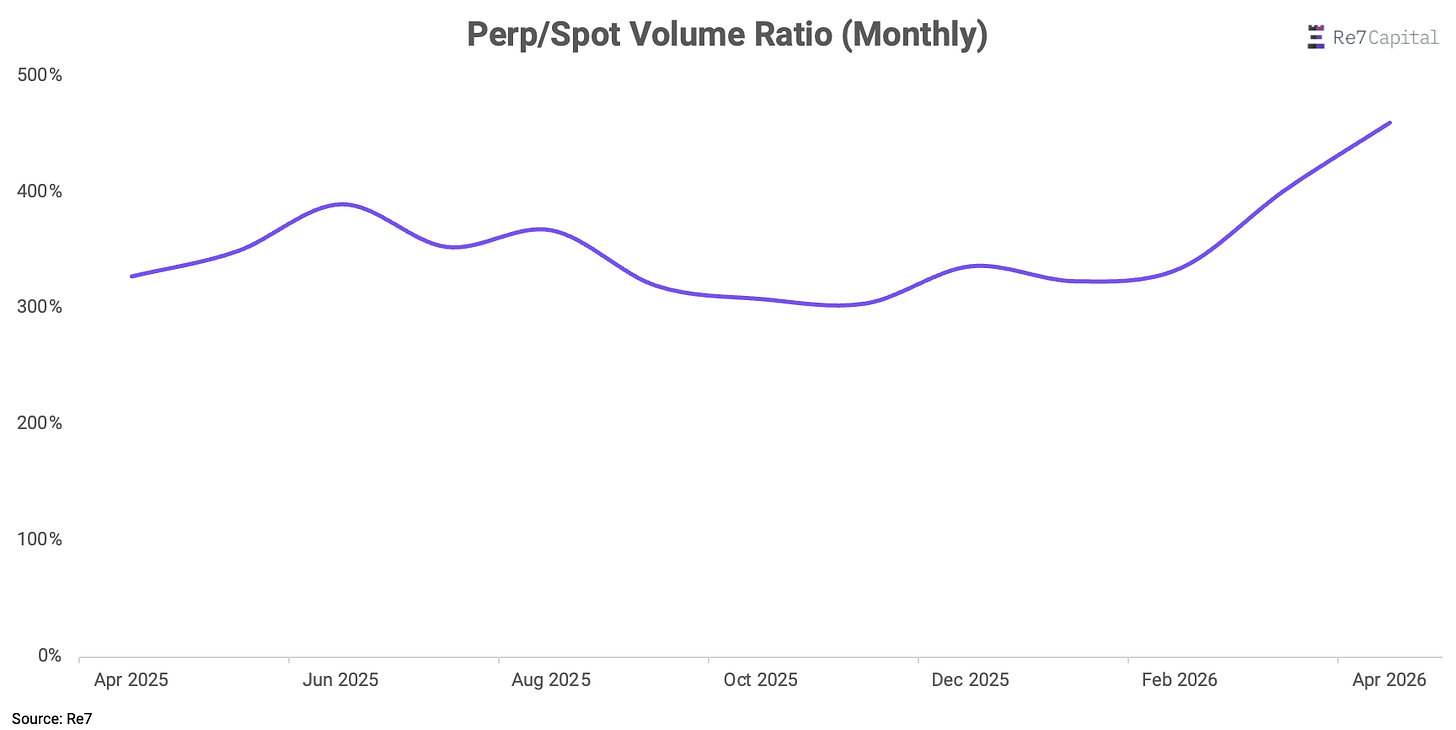
For years, that market was effectively Binance. Now we’re seeing a structural shift towards minimally extractive platforms where traders prefer to express their strategies for a variety of reasons:
Fee competition — DEX venues are structurally cheaper and don’t carry the operational overhead that puts a floor under incumbent pricing
Uptime and resilience — October 2024 made the reliability gap visible. Traders who moved to venues that stayed operational during the volatility largely stayed there
Cross-margin and composability — on-chain venues now support cross-margin collateral and integrate natively with the broader DeFi stack, giving sophisticated traders capital efficiency that CEXs can’t replicate structurally
UX parity — the friction argument for staying on a CEX has largely gone. On-chain execution has caught up to the point where UX is no longer a meaningful barrier for the traders that matter most to volume
Broader competitive pressure — faster listings and aggressive fees from mid-tier CEXs, plus expanding institutional alternatives, have eroded the incumbents’ captive flow
DEXs vs. CEXs Relative Momentum
The result is a derivatives landscape that looks meaningfully different from just 12 months ago.
Today, 20% of derivative CEX volume is now being generated on-chain, up from 8% just 12 months ago (2x).
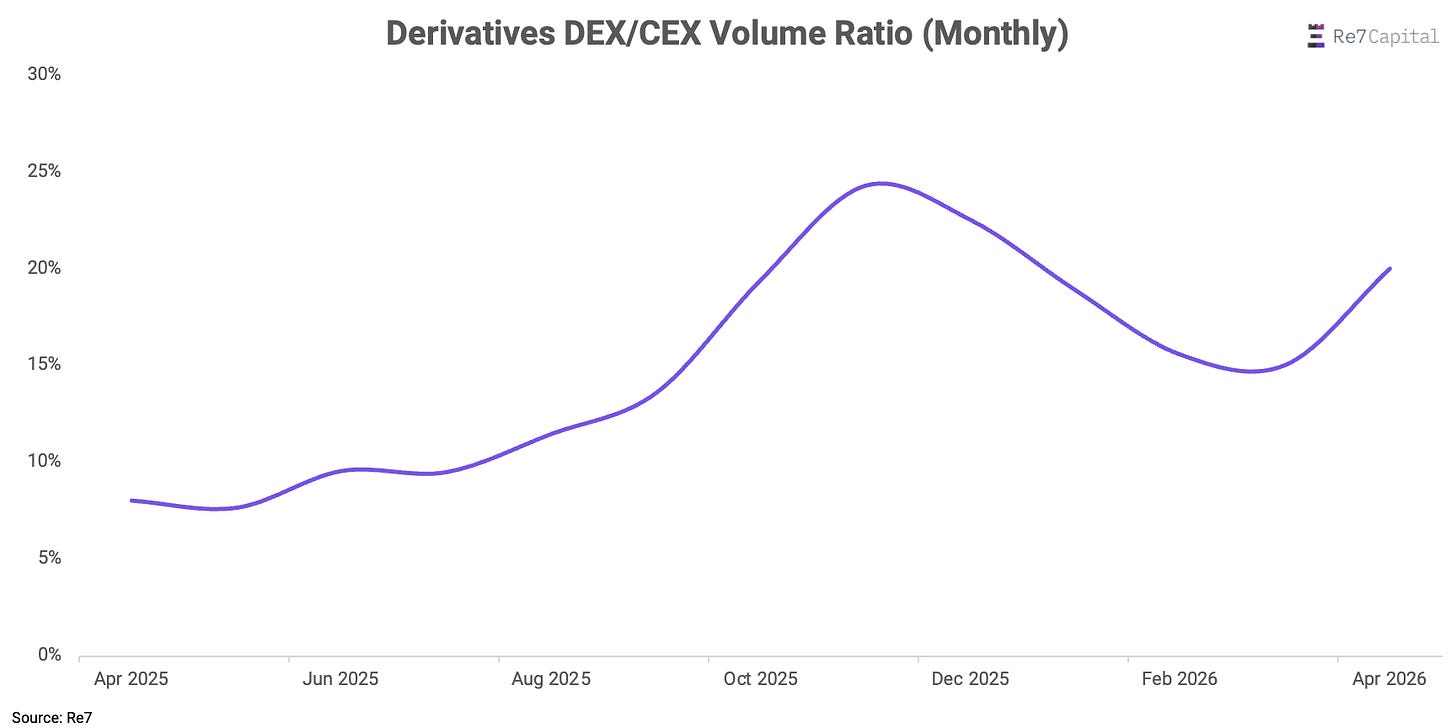
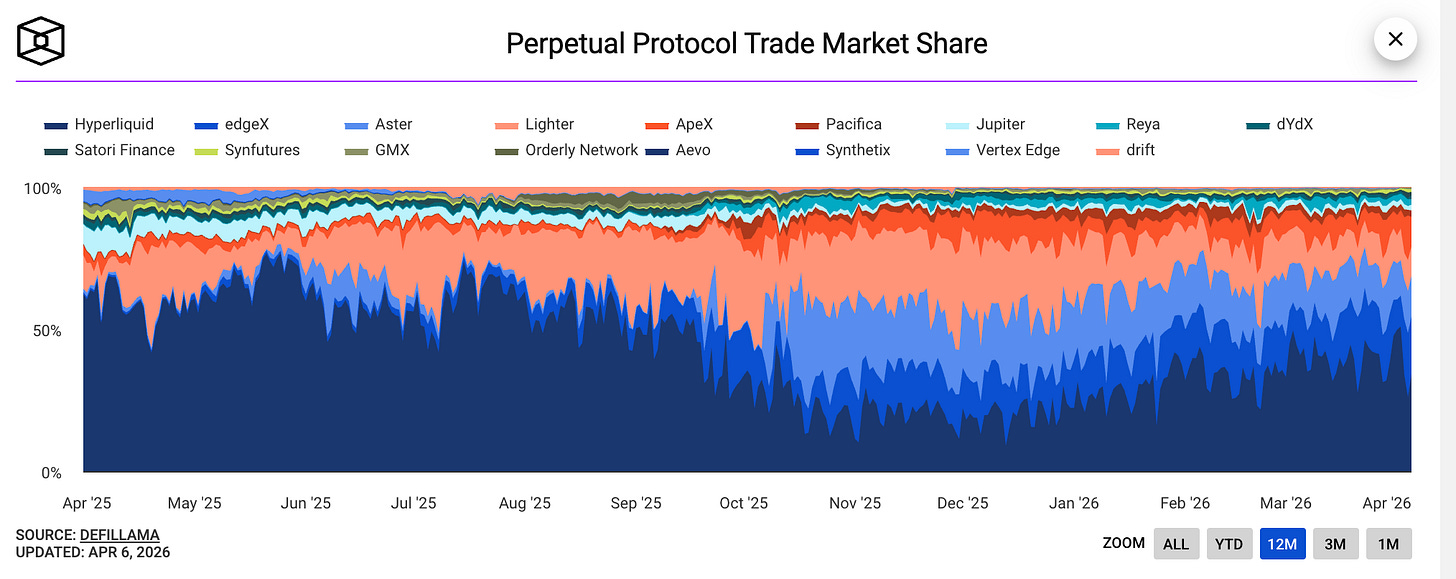
Within the perpetual DEX landscape, Hyperliquid continues to dominate the market at ~40%. The next four largest venues are evenly distributed at ~10% market share.
There seems to be a lesson in the market share flux here.
Most attempts to compete in perps to Hyperliquid have leaned on token incentives to seed volume. The problem is that it shows, when traders rotate out of the token, the activity goes with them. Their traction hasn’t always been organic.
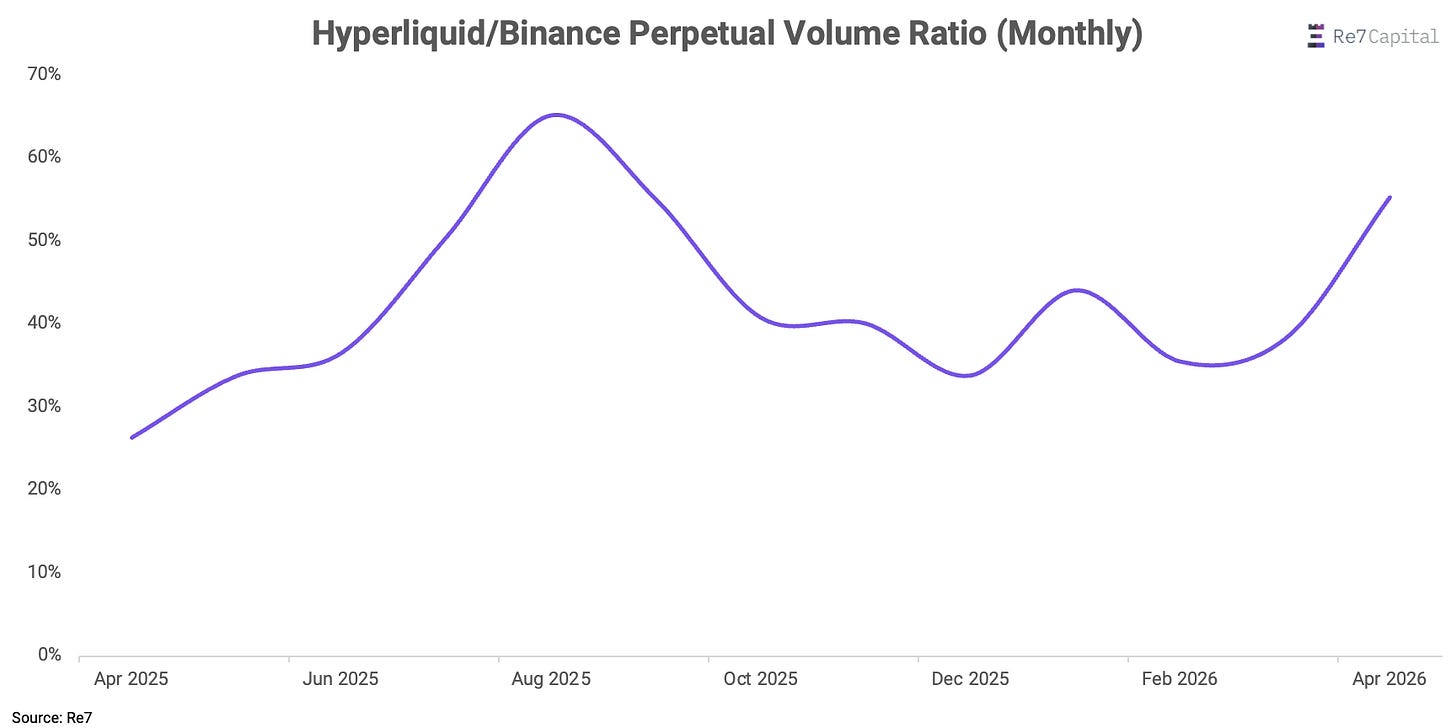
Binance remains the dominant CEX in perpetuals, but the gap with the leading DEX is closing fast. Twelve months ago, that venue was doing around 25% of Binance’s perp volume. It’s now at 55% — 2x in relative terms in a single year.
The most compelling part of the DEX vs CEX story isn’t the volume shift — it’s what that volume shift means as a business.
Imagine a DEX with a near-zero cost base running at roughly 99% margin on trading fees. Now compare that to the incumbent centralised venue, which carries all of those costs and operates at closer to say 50% margin.
This means DEXs can generate 2x more profit per unit of volume than their centralised counterparts.
Blended fee rates could reasonably be 0.03% for a market leading DEX vs. 0.035% for Binance.
The chart below plots two lines against Binance: a volume ratio, and an implied profit ratio. The gap between them is the structural point.
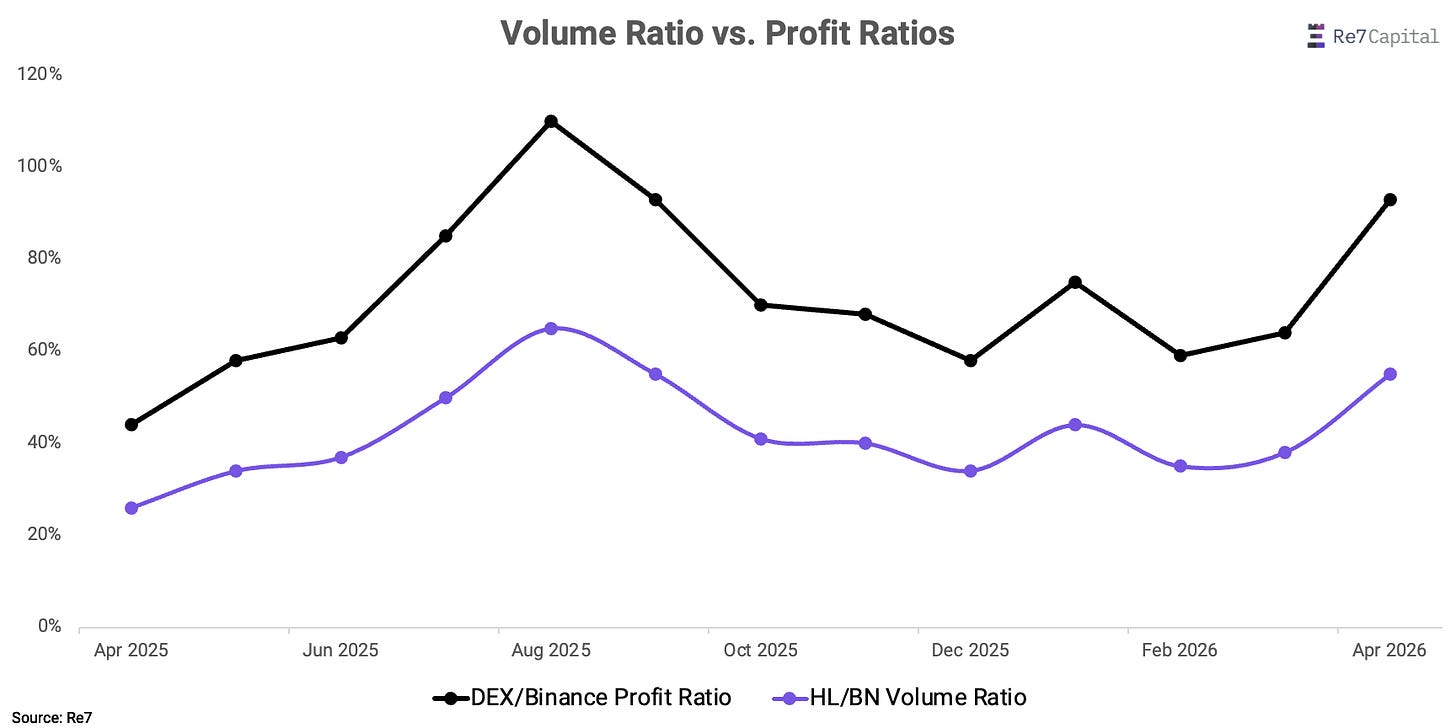
Comparing volume and profit ratios between an example DEX with 0.03% blended fee rates and 99% margin and Binance with 0.035% and 50% margin.
The DEX doesn’t need to match Binance volume-for-volume to generate comparable profit — the margin differential does the work.
Every percentage point of volume share it gains translates into roughly double that in profit share. As the volume gap closes, the profit gap closes faster.
And crucially, that profit doesn’t disappear into a corporate cost structure — it gets recycled back into the protocol, whether through token buybacks, liquidity incentives, or product development, creating a compounding flywheel that makes the platform progressively harder to compete with.
Market Update
Markets are either seeing past and discounting the constant aggressive rhetoric by Trump and/or pricing in a greater likelihood of resolution in the Middle East.
BTC is looking to re-gain $70k and is up +10.7% from the conflict start lows in late February.
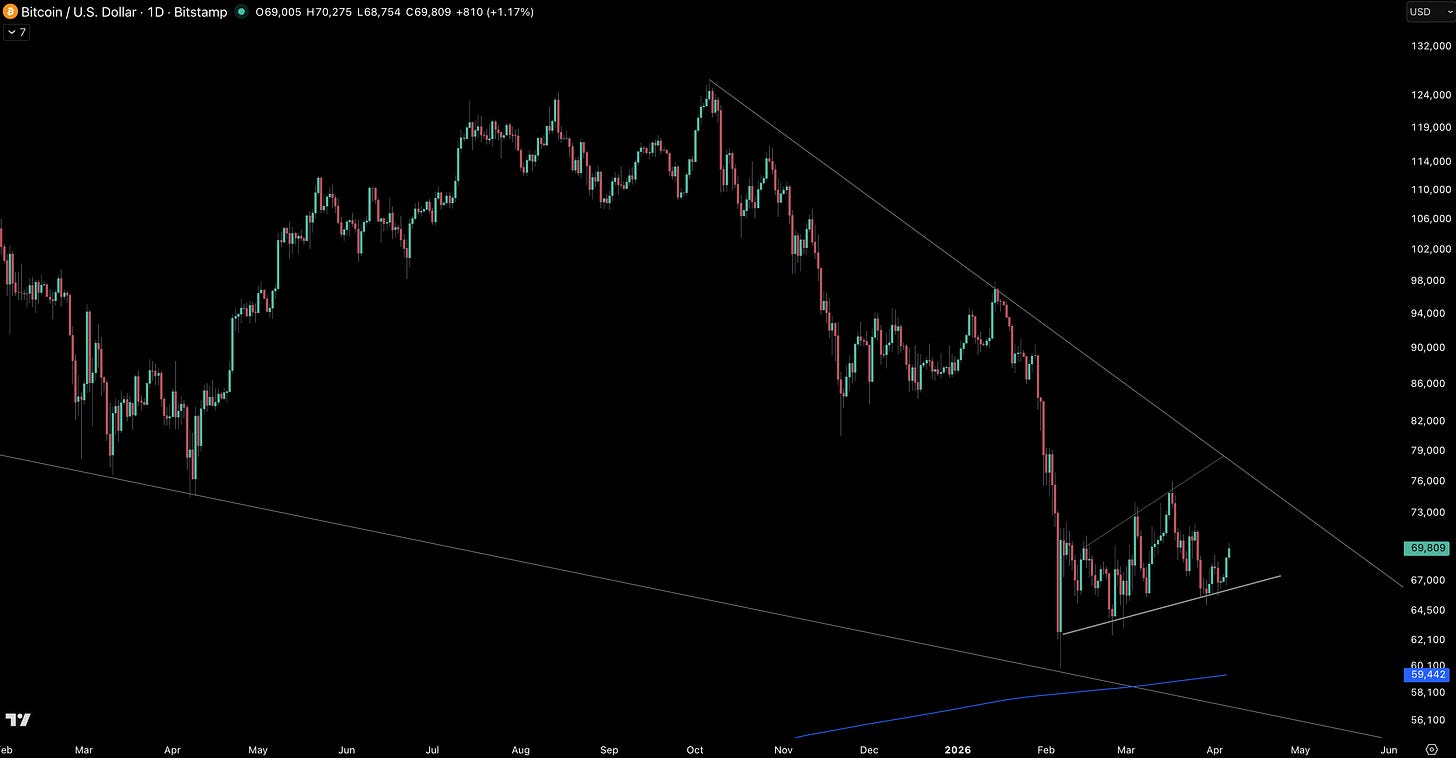
BTC/USD (daily).
There continues to be signal in the BTC/Brent ratio.
The ratio has not broken down (in fact rallying off 620 lows again), suggesting the market is so far treating this as a geopolitical supply shock rather than a risk-off macro event.
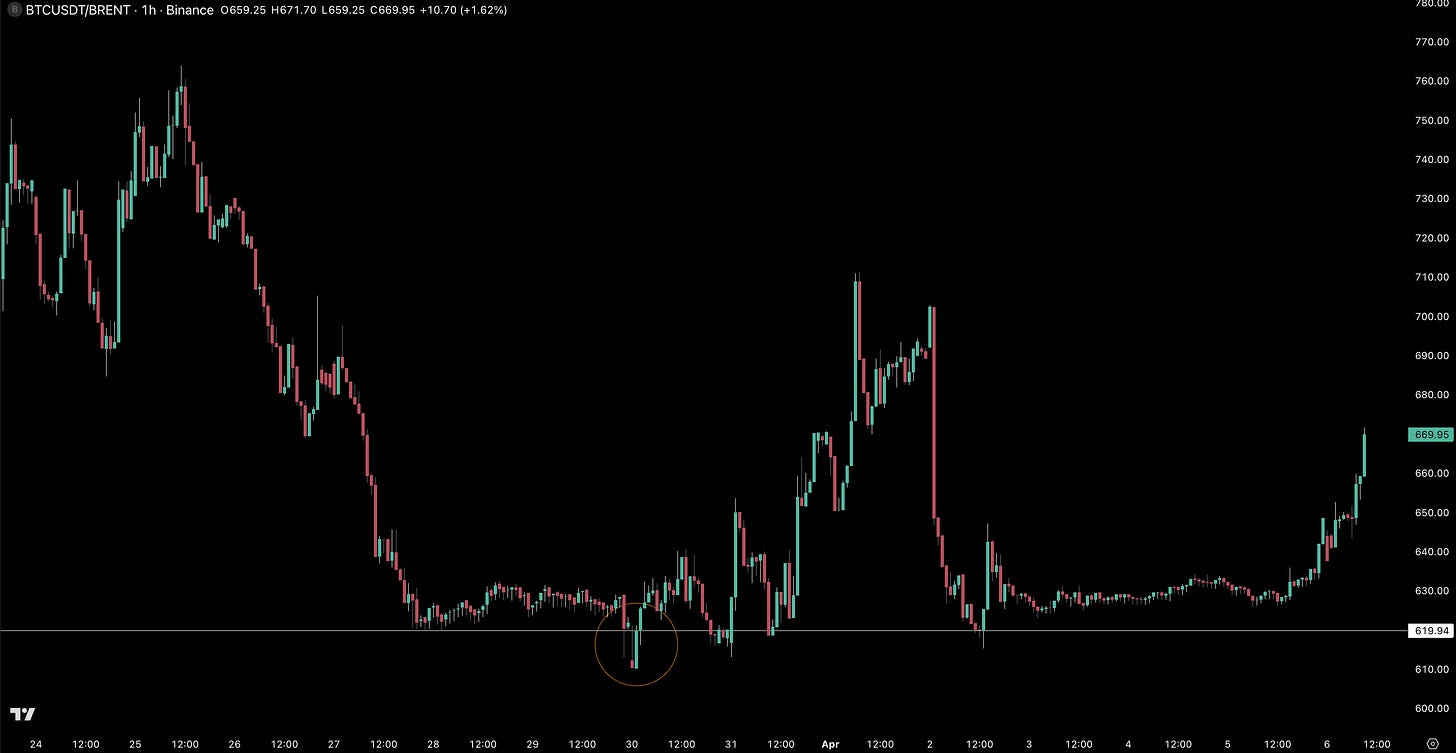
BTC/brent crude (hourly).
If anything, the resilience of BTC against a commodity that is directly pricing in the conflict is a signal worth watching.
If the geopolitical premium starts fading from oil, this is where we may see long duration assets like BTC etc catching stronger bids.
At the same time, US domestic liquidity conditions continue to improve as the business cycle progresses. Against that backdrop, total altcoin market capitalisation is currently holding at a key support level — being buoyed by liquidity undercurrents.
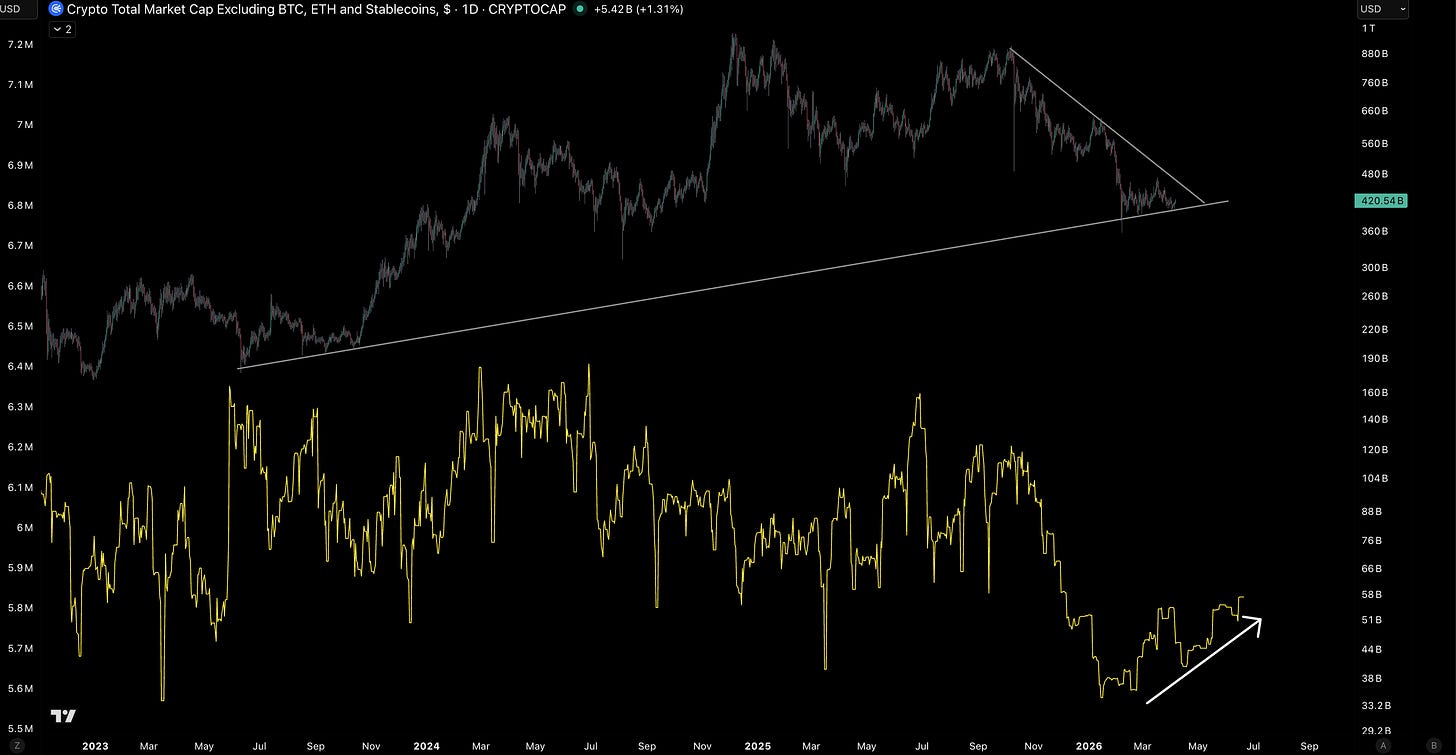
Daily global altcoin market capitalisation ($) vs. US domestic liquidity (yellow).
Tokenised real-world asset value has surpassed $28B where the most consistent growth in the last month has been from US treasury debt.
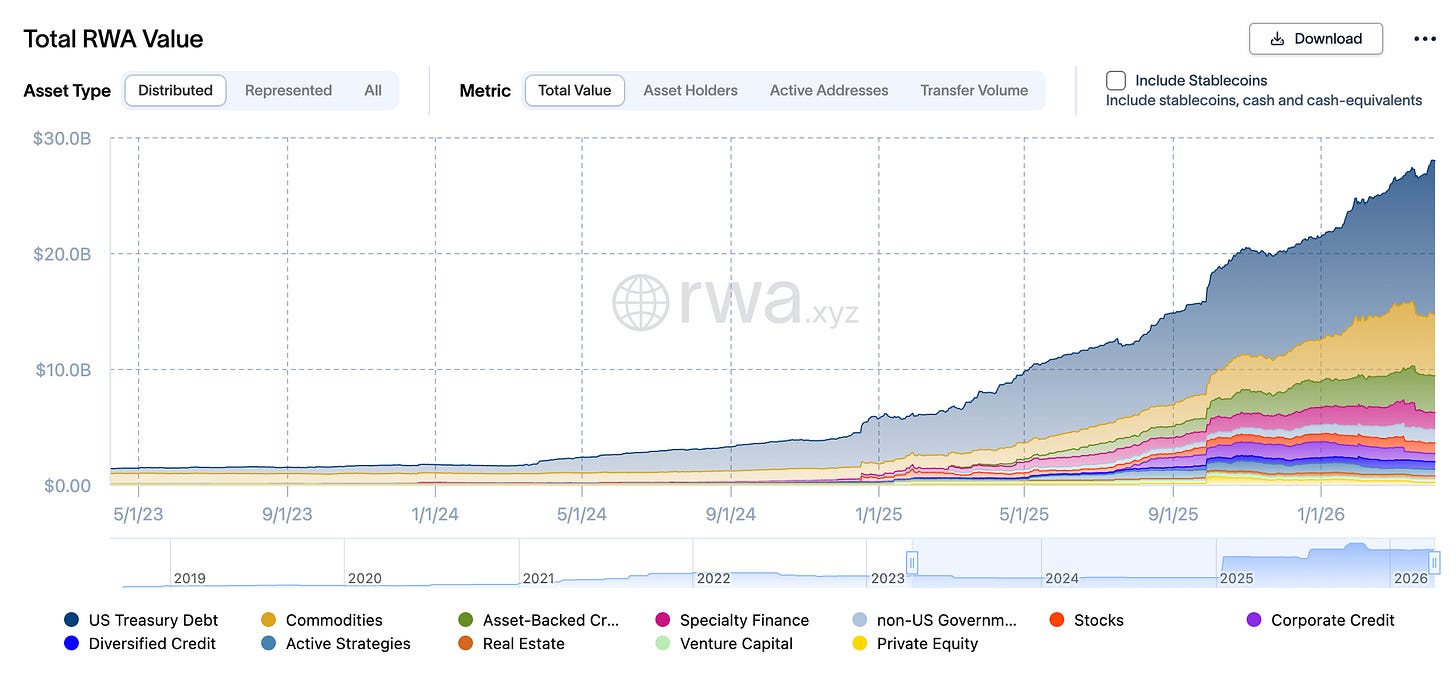
Total RWA value on-chain.
One key driver has been Circle’s USYC tokenised money market fund with its AUM up 60% YTD.
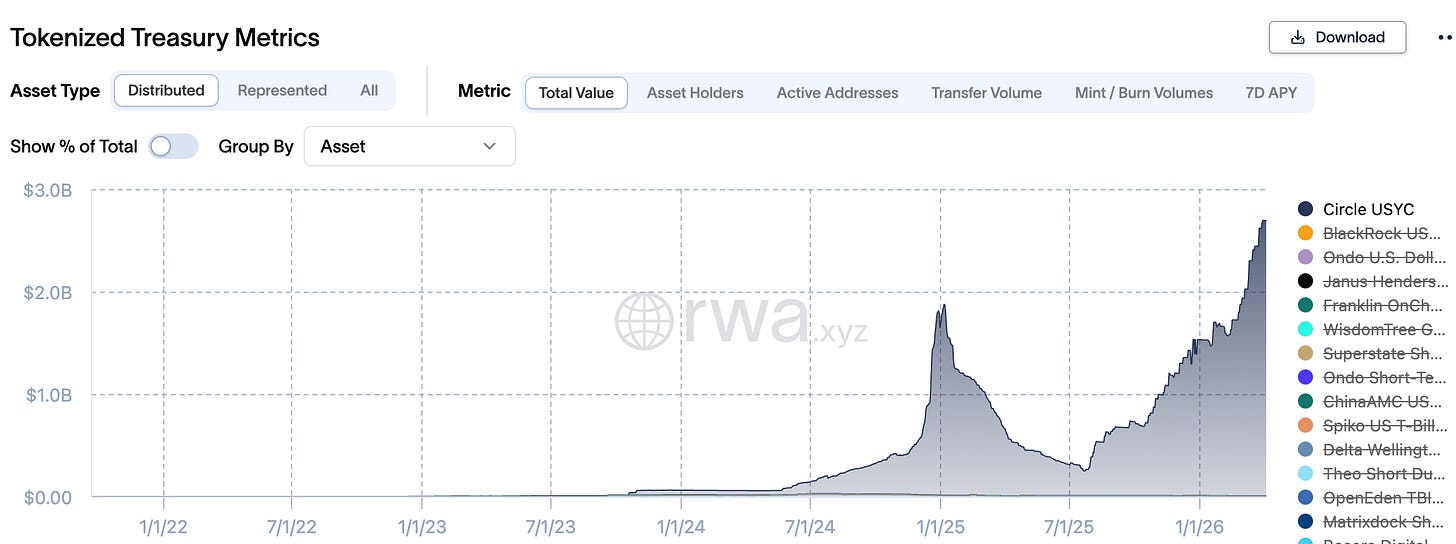
Circle USYC tokenised treasury value ($).
State of the Yields
Stablecoin lending yields:
~2% on Aave (USDC), still below the ~3.6% 3-month T-bill rate. Variable-rate premiums remain compressed.
Fixed-rate DeFi lending: yield premium in fixed markets marginally expanding from last week:
Pendle sNUSD: 8.4% (Jun 2026)
Pendle sUSDAi: 6-8% (Jun-Oct 2026 maturities)
sUSDe holding: ~3.5%, down from ~4.7% last week
ETH yield benchmarks:
Lido staking: ~2.37% (flat over the past week)
Disclaimers
The content is for informational purposes only. None of the content is meant to be investment advice. Use your own discretion and independent decision regarding investments. The opinions expressed in all Re7 public research articles are the independent opinions of the authors at the time of publication and not the opinions of the affiliates of Re7.
Please see here for full disclaimers.
Thanks for reading Re7 Research! Subscribe for free to receive new posts and support our work.