The Weekly: The Yield You See Is the Risk You Take
MAY 18, 2026
DeFi yield mispricing, Pudgy Penguins' rise as a crypto-native brand, the CLARITY Act advancing toward a Senate vote, and Bitcoin's leverage washout — this week's briefing covers where the real opportunities and risks sit across crypto markets.
Re7 Capital has continued to expand its institutional product suite and distribution reach through Q1 and into Q2:
Anchorage Digital integration - Re7 has partnered with Anchorage to allow Qualified Custody of mRe7ETH. DATs and other institutional ETH holders that are mandated to Qualified Custody can now access mRe7ETH.
ETH Yield Strategy — Re7 has launched mRe7ETH on Optimism, an ETH-denominated, market-neutral yield strategy designed for institutional allocators.
Telegram Wallet integration — Re7's DeFi yield strategies are now available within Telegram's self-custody TON Wallet, enabling users to access on-chain yield directly within the app.
Zodia Custody partnership — Re7 partnered with Zodia Custody, which provides custody and off-exchange settlement, and enables on-chain representation of Re7's BTC Yield and Market Neutral strategies.
Weekly Summary
We cover:
where the mispricing sits across DeFi yield strategies
how an internet-native brand builds a real ecosystem
how the CLARITY Act is progressing and implications
The Yield You See Is the Risk You Take
Last week we argued that DeFi exploit headlines are scarier than the underlying data: losses are concentrated in the long tail, not core infrastructure.
If the market is discounting DeFi risk too broadly, the next question is where the mispricing sits.
This chart maps major DeFi yield strategies by complexity, tail risk, and APY. The relationship is clear: yield rises with structural risk. Native staking sits at 2–8% for cleaner exposure, while looping and basis trades can reach 25% only by adding liquidation, funding, and counterparty risk.
The curve is fair compensation: the return you should expect for each level of risk.
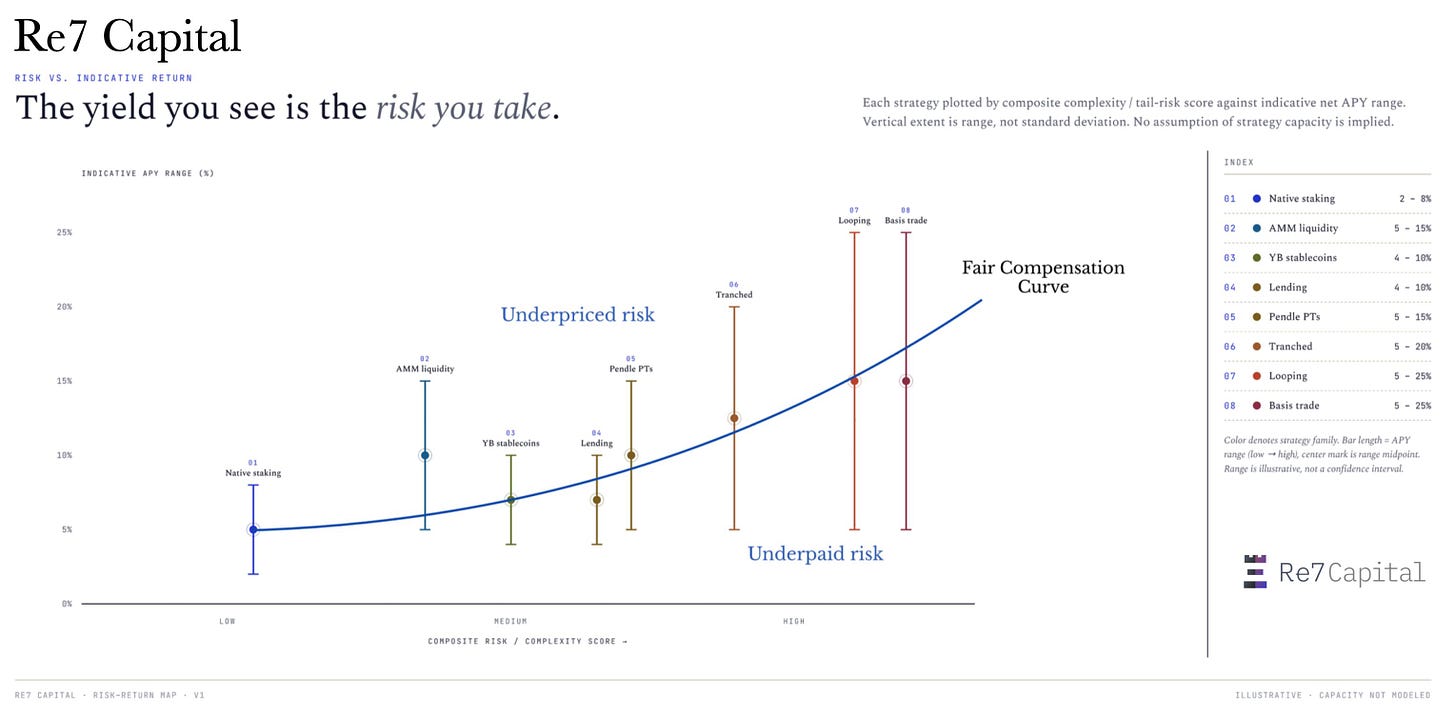
The opportunity is the gap above it. In a market that discounts DeFi risk indiscriminately, some strategies can pay more than their actual risk warrants — not because the risk has disappeared, but because sentiment has overshot.
The allocator’s question is simple: am I being paid for this risk, or just taking it?
WallStreetBets on Pudgy Penguins
WallStreetBets posted a thread highlighting Pudgy Penguins as an example of how internet-native brands are evolving.
The post focuses less on speculative market dynamics and more on the broader ecosystem: brand recognition, cultural reach, NFT roots, physical merchandise, and growing consumer distribution.
That framing now sits alongside a more formal market-structure development: Canary Capital even filed for a Pudgy Penguins-linked ETF.

Pudgy Penguins at the NASDAQ opening bell in June 2025.
The significance is that this comes from WallStreetBets, one of the most important retail-trading communities of the last cycle.
During the GameStop episode, WallStreetBets helped concentrate retail attention around a single market narrative, contributing to extreme market activity: analysis cited record trading days worth $32.46bn and $12.82bn during the 2021 rally.
WallStreetBets frames Pudgy Penguins as an example of how internet-native culture is moving beyond pure virality and towards brand distribution.
In that context, WallStreetBets placing Pudgy Penguins inside the same retail-attention lineage is notable.
Their framing is that Dogecoin proved simple, recognisable internet culture can become financialised. Pudgy Penguins is being positioned as a more developed version of that idea: a crypto-native brand with IP, community, NFTs, merchandise, mainstream touchpoints, and more than 100bn cumulative GIF views.
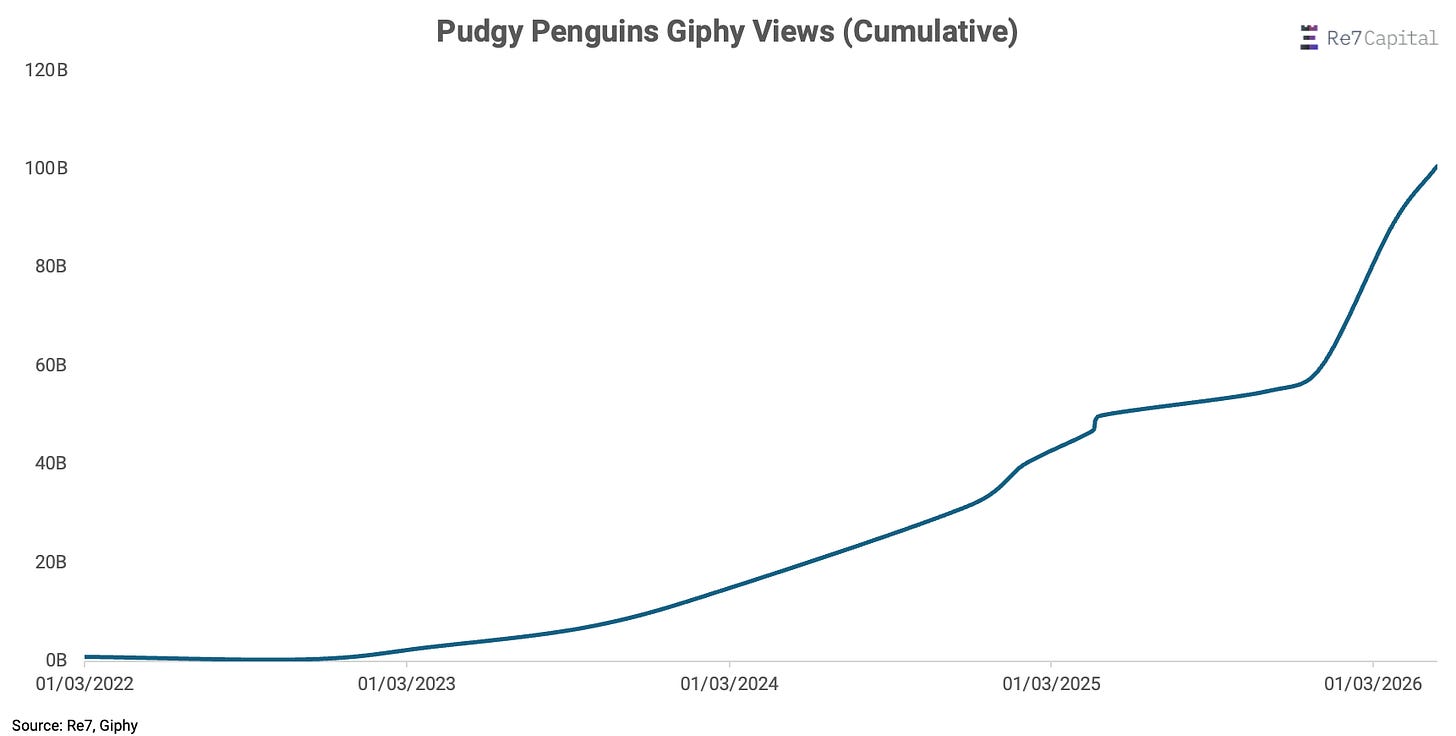
The key point is that Pudgy Penguins is not just an internet brand in isolation. It is an ecosystem testing whether crypto-native culture can become a wider consumer and community network.
Getting CLARITY: the Act nears a Senate vote
The CLARITY Act advanced out of the Senate Banking Committee last week, moving a U.S. crypto market structure bill closer to a full Senate vote. In simple terms, the bill aims to clarify which regulator oversees which parts of crypto markets — mainly the SEC for digital securities and the CFTC for digital commodities.

The significance is that this is broader than a stablecoin bill or another enforcement action. It is a step toward a formal U.S. rulebook for crypto, replacing years of regulatory uncertainty with clearer classifications, trading rules, and oversight.
The bill now awaits a floor vote, though no date has been set.
Market Update
BTC cooled off last week, falling 5.8% and stalling just short of its 200-day moving average after approaching it from below.
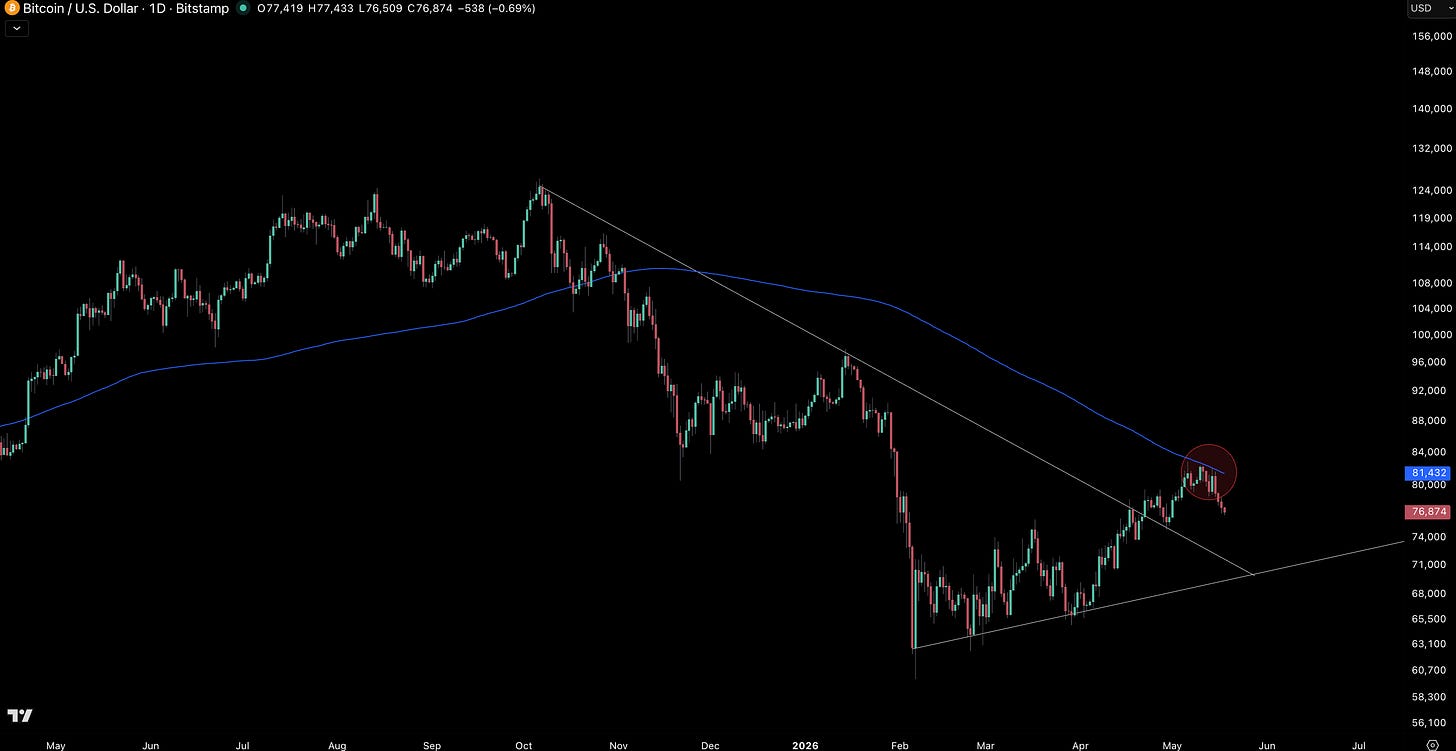
BTC/USD (daily).
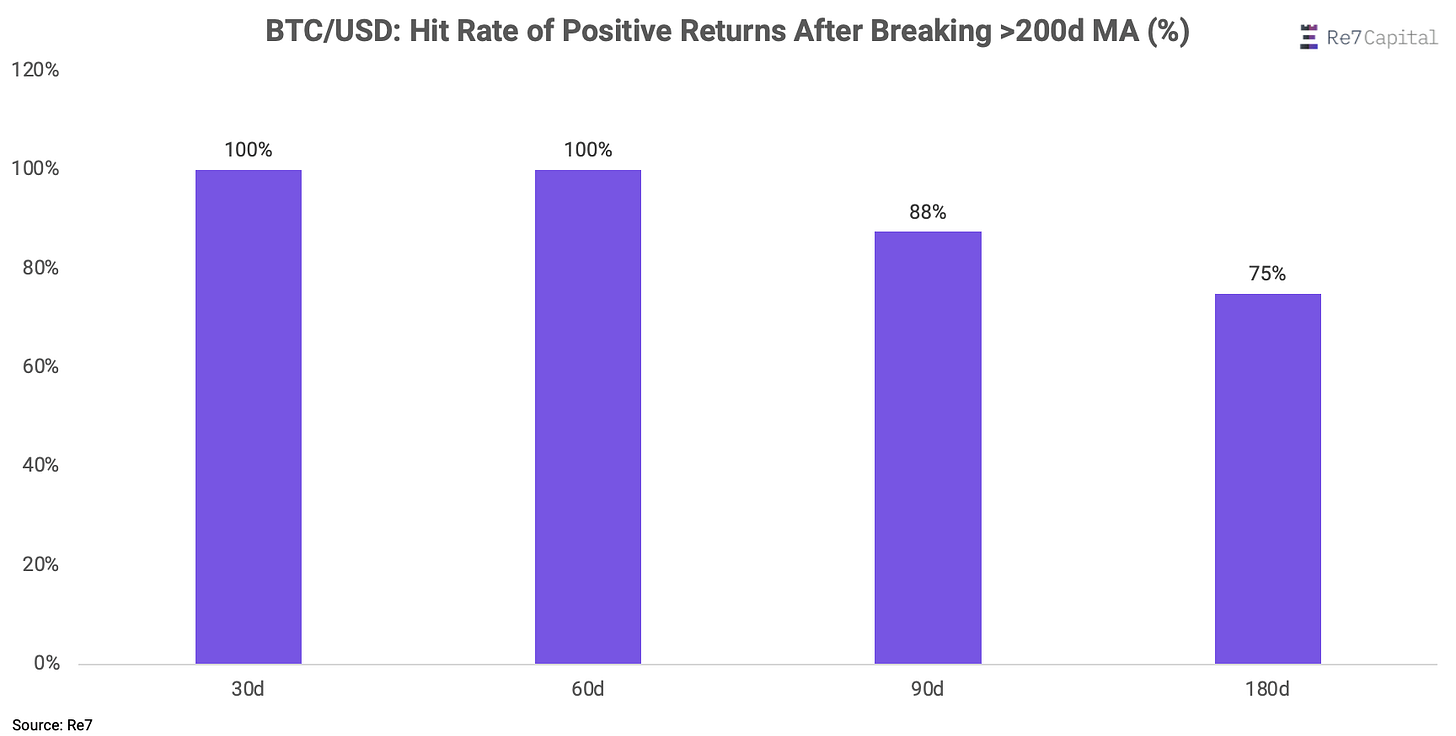
The 200d MA is a key level that investors place significant weight on. It continues to act as an important longer-term conviction level and you can see it in the performance data.
Based on the 8 times BTC has reclaimed its 200d MA since 2019, returns averaged +18% at one month, +33% at two, and +42% at three — 3-5x a random-day entry.
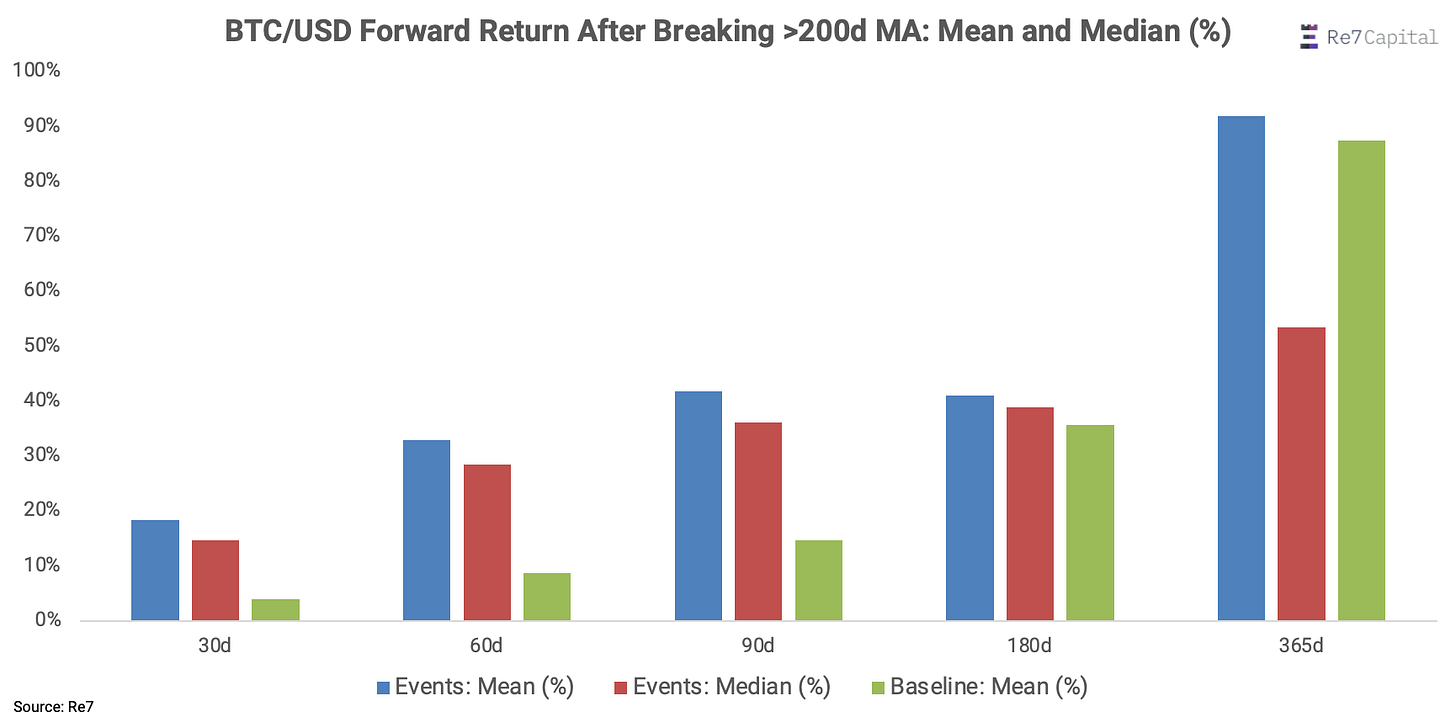
Put differently, the hit rate is heavily skewed to the upside across periods out to 180 days after a clear breakout.
Investors crowded the long side and got over their skis, assuming a breakout was inevitable. Long liquidations have surpassed $1.9b over the last week alone.
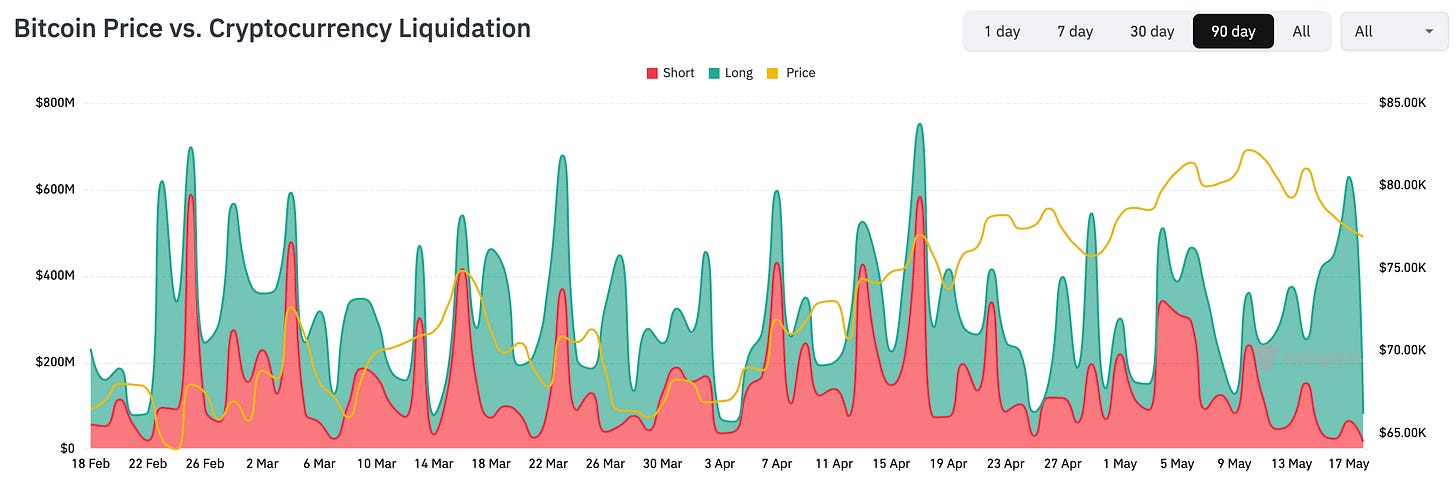
In other words, this looks more like a leverage washout than a change in trend.
BTC ran into a key conviction level, longs crowded the move too early, and the market forced a reset before the breakout was confirmed.
With equities still near all-time highs and liquidity conditions continuing to improve, the pullback looks more technical than macro-driven. And Bessent has every incentive to keep rates down.
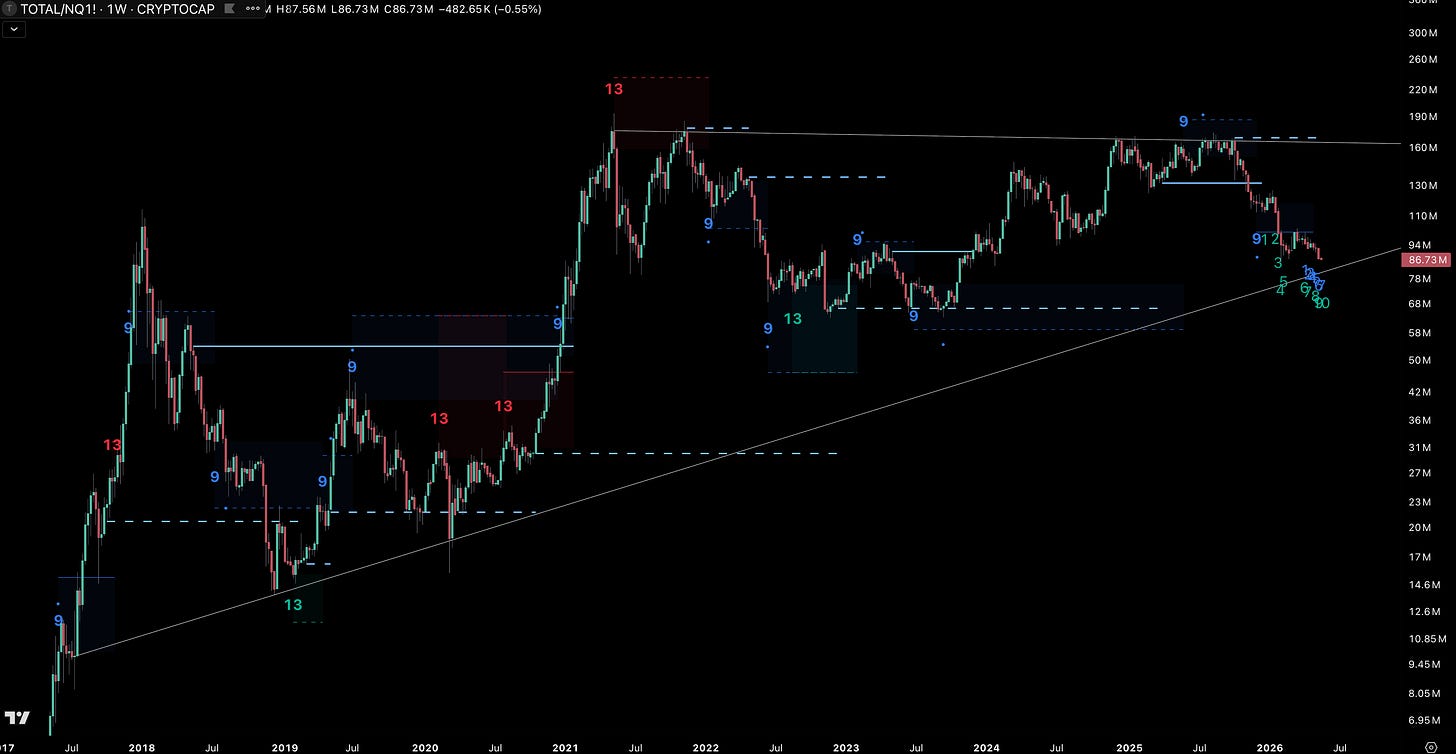
This is happening as the crypto/NASDAQ ratio is roughly 2–3 weeks away from a potential DeMark buy setup, suggesting crypto may be approaching an exhaustion point relative to equities after a dramatic AI-led run in large-cap tech.
This is creating a temporary divergence between crypto’s relative performance and the broader economic growth picture. Crypto continues to lag the NASDAQ, even as the growth backdrop improves.
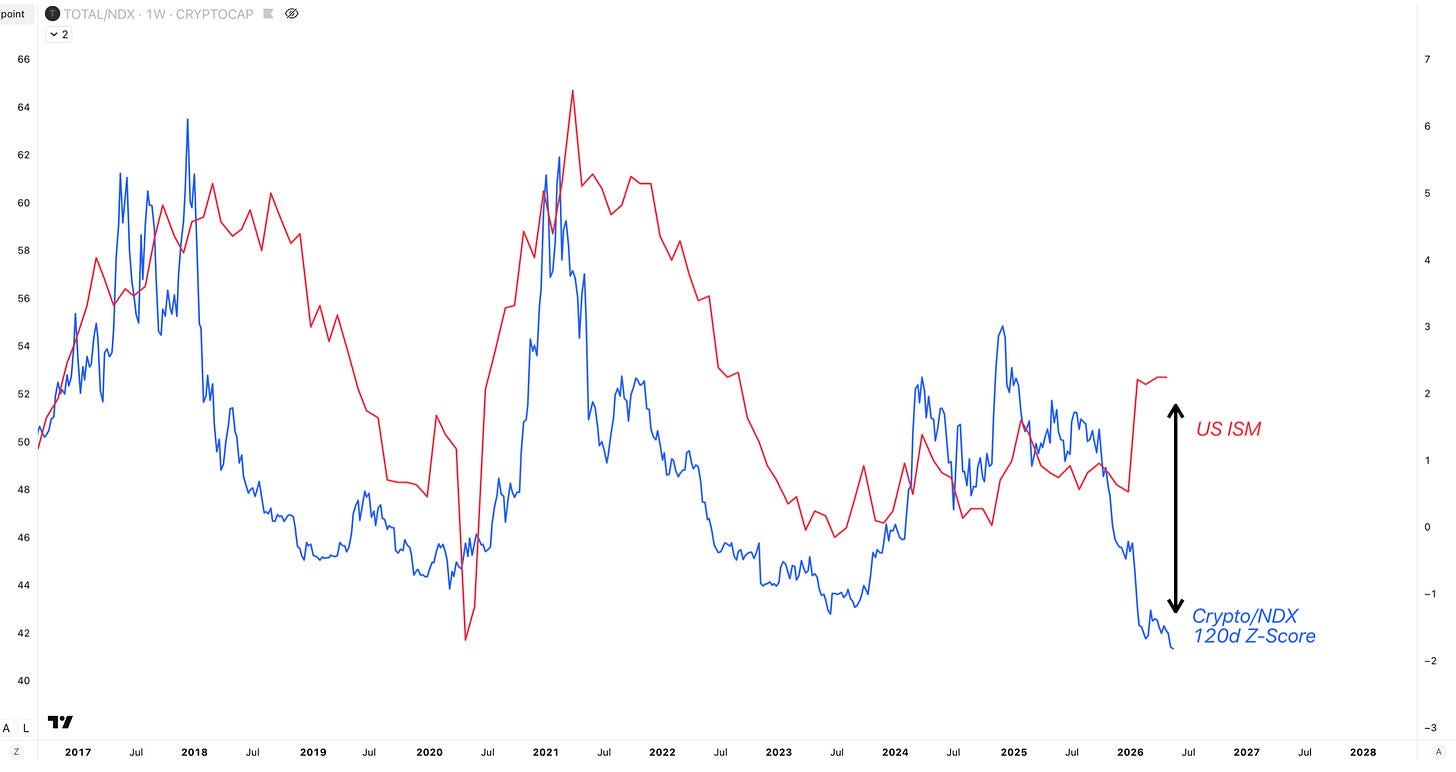
If that momentum continues, the gap looks increasingly difficult to sustain.
State of Yields
Stablecoin lending yields:
~3.36% on Aave (USDC) — utilisation rates for USDC markets are still elevated but have seemed to stabilise at ~91%.
5.12% on Aave (MegaUSD) — same as last week again. Higher MEGA incentives driving supply side. Looping is pulling USDm out of the pool where new suppliers keep arriving for MEGA APY.
Fixed-rate DeFi lending: yield premium in fixed markets marginally expanding from last week:
Pendle sNUSD: 8.2% (Jun 2026)
Pendle sUSDAi: ~10% (Jun-Oct 2026 maturities)
sUSDe: ~4.1%
ETH yield benchmarks:
Lido staking: ~2.37% (slight decrease from previous week)
About Re7
Re7 Capital is a research-driven digital asset investment firm specialising in DeFi yield and liquid alpha strategies.
Disclaimers
The content is for informational purposes only. None of the content is meant to be investment advice. Use your own discretion and independent decision regarding investments. The opinions expressed in all Re7 public research articles are the independent opinions of the authors at the time of publication and not the opinions of the affiliates of Re7.
Please see here for full disclaimers.